Why do so many people feel emotionally exhausted, even after doing everything “correctly”?
Why do people today have more freedom than ever before, yet feel more anxious, lost, and empty?
Why are so many people terrified of:
- choosing the wrong career
- wasting their lives
- never becoming who they were “meant” to be?
As one person wrote online:
“Existentialism is like writing your own story when there’s no script.”
And maybe the most uncomfortable question is:
What if there is no single “correct” version of your life?
From an Eastern philosophical perspective, modern suffering begins here. People want certainty before action, meaning before experience, and answers before living. But both Existentialism and many Eastern philosophies suggest something very different.
Main Idea of This Article
Modern life feels empty not because people lack success, comfort, or freedom, but because they keep searching for a guaranteed meaning, a perfectly correct life, and absolute certainty in a world that cannot provide them. Existentialism, especially through thinkers like Jean-Paul Sartre and Albert Camus, argues that meaning is not something automatically given by society, religion, or the universe. From an Eastern philosophical perspective, suffering increases when people become attached to fixed identities, permanent answers, and the illusion of total control. The central insight of both traditions is that life becomes meaningful not by finding guaranteed answers first, but by consciously living, choosing, loving, creating, and participating in life despite uncertainty.
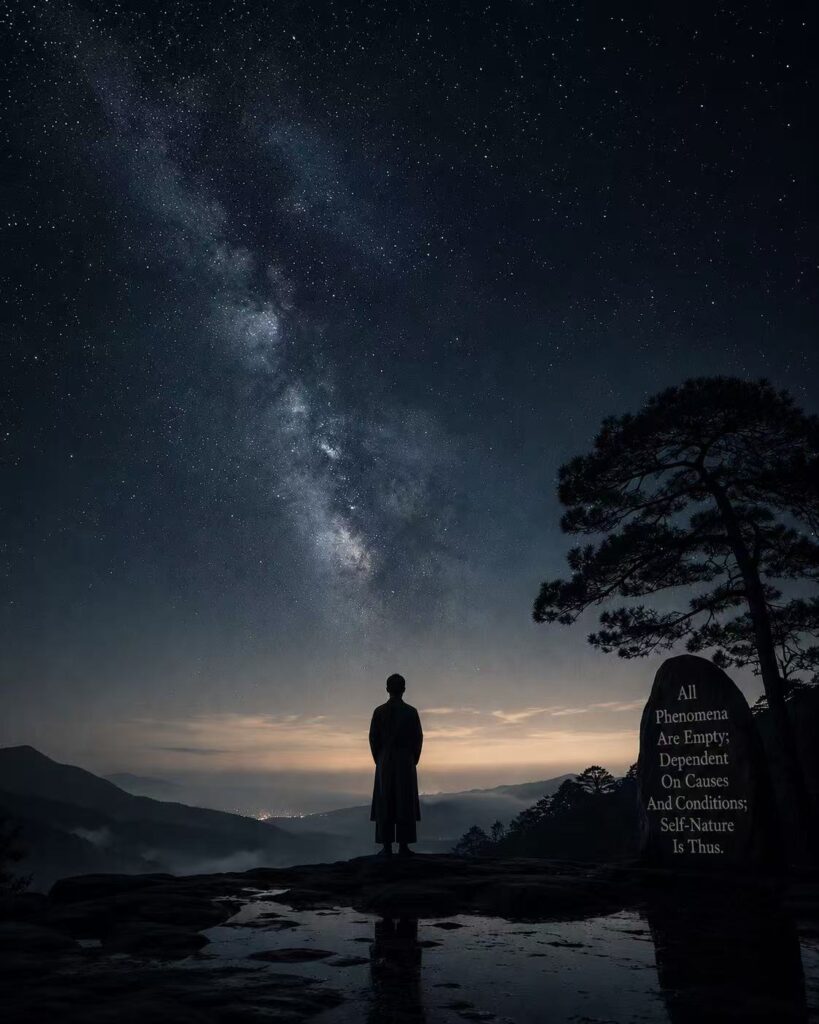
Why Freedom Creates Anxiety
Modern people can choose almost everything: career, identity, beliefs, relationships, and lifestyle. At first, this sounds liberating. But freedom also creates responsibility. In the past, meaning often came from religion, family roles, tradition, and social structure. Modern life removed many of those fixed answers. Now people must decide for themselves who they are, what matters, and how to live. That freedom can feel overwhelming. Much of modern anxiety comes from searching for the “correct life”: the correct job, the correct relationship, and the correct purpose. But existentialism questions whether such certainty even exists.
“Existence Precedes Essence”
One of Sartre’s most famous ideas is:
Existence precedes essence
Human beings are not born with a fixed purpose. First, you exist. Then, through choices and experiences, you gradually become who you are. From an Eastern perspective, suffering often comes from attachment to fixed identities and permanent certainty. People want a guaranteed future, a stable identity, and a perfectly meaningful life. But reality constantly changes. Life cannot be fully controlled.
The Fear of Choosing Wrong
Many people are not simply afraid of failure. They are afraid of regret. They fear wasting their lives, choosing the wrong path, and never becoming their “true self.” Existentialism responds with a difficult idea:
Maybe there is no single correct path.
Meaning is not fully discovered in advance. It emerges through living. This is why existentialism emphasizes action. Many answers only become clear after experience, not before it.
Why Success Still Feels Empty
Modern culture constantly pushes people to achieve more, optimize themselves, and become more successful. Yet many still feel empty. Why? Because success cannot answer deeper questions: What truly matters? Am I living authentically? Am I choosing my life, or following expectations? Albert Camus described this tension as “the absurd”: humans desperately seek meaning, while the universe remains silent. But existentialism is not nihilism. It does not say:
“Nothing matters.”
It says:
“Meaning is not automatically given.”
Meaning is created through love, responsibility, relationships, courage, and conscious action. Not because the universe guarantees meaning, but because humans choose to live meaningfully anyway.
The Real Challenge of Existentialism
Modern people often wait for certainty before truly living. But existentialism suggests certainty may never fully arrive. And that is not failure. It is part of being human. Perhaps life is not about discovering a perfect path. Perhaps it is about learning how to live consciously in a world without guarantees. To choose anyway. To act anyway. To love anyway. And to create meaning through living itself.
Modern society often assumes that science and technology will eventually explain everything: the universe, consciousness, human behavior, even happiness itself. Yet despite unprecedented scientific progress, many people still feel emotionally empty, disconnected, and uncertain about the meaning of their lives. Why? If humanity understands more about the external world than ever before, why does inner confusion remain? In the next article, Can Science Explain the Meaning of Life? Why Modern Life Still Feels Empty, we will explore whether science alone can answer humanity’s deepest existential questions — or whether the search for meaning ultimately goes beyond logic, data, and material progress.
What Is the Meaning of Life? An Eastern Philosophy Guide to Humanity’s Greatest Question Meaning of Life