This article reflects my understanding after many years of studying Buddhism and presenting its ideas in a way that is accessible to Western readers. You may not agree with every perspective—and that’s perfectly fine. My hope is simply to offer another way of looking at one of life’s biggest questions.
Introduction: Perhaps You’re Looking in the Wrong Direction
Many people spend years searching for their life’s purpose.
They compare themselves with others, chase impressive careers, pursue wealth or recognition, or wait for a moment of sudden inspiration. Yet even after achieving what they once desired, many still feel something is missing.
From a Buddhist perspective, this isn’t because you haven’t searched hard enough. It’s because you’ve been searching in the wrong place.
Buddhism teaches that your true purpose is not something hidden somewhere in the outside world, waiting to be discovered. Instead, it gradually reveals itself as your mind becomes clearer.
Finding your purpose, therefore, is less about finding something new and more about removing what prevents you from seeing what has always been there.
1.Stop Looking Outside: Your True Nature Is Already Complete
When people ask, “What is my purpose?” they often expect someone else to give them the answer.
They look to society, successful people, family expectations, or social media for direction. They ask:
- Which career earns the most money?
- Which path earns the most respect?
- Which lifestyle looks the most successful?
Buddhism encourages a different question.
Instead of constantly asking the world who you should become, begin asking yourself what has been covered up by fear, attachment, and endless distraction.
One famous passage from the Platform Sutra (六祖坛经) says:
“How unexpected! Our original nature is inherently complete.”
In Buddhism, this original nature is often called Self-Nature (自性, zìxìng). It does not mean the ego or personality. Rather, it refers to the mind’s fundamental capacity for wisdom, compassion, and clarity.
Imagine a deep well filled with clear water.
If mud keeps falling into the well, the water appears dirty. But the water itself has never disappeared.
Likewise, your deepest aspirations are often buried beneath anxiety, comparison, fear of failure, and attachment to external success. As these mental obstacles gradually settle, your genuine direction becomes easier to recognize.
This is why Buddhist practice emphasizes looking inward rather than endlessly seeking outside approval.
Your purpose is not something you import from the world.
It is something you gradually uncover.
2.Transform the Way You Define Success (转识成智)
Even after discovering a direction, another question arises:
How do I know whether this is the right goal?
Buddhism answers this through the principle known as Turning Consciousness into Wisdom (转识成智, zhuǎn shí chéng zhì).
Rather than allowing our decisions to be driven by attachment, craving, or ego, we gradually transform the way we see the world.
Most people naturally ask:
- What can I gain?
- How much money will I make?
- Will people admire me?
- Will this make me successful?
These questions are understandable, but Buddhism suggests they are incomplete because they are centered on acquisition.
Instead, try asking:
- What qualities will this path help me cultivate?
- What wisdom can I gain?
- How can my work reduce suffering?
- How can I contribute to others while continuing to grow myself?
This subtle shift changes everything.
Your purpose is no longer measured only by external achievements, but by the person you are becoming.
Buddhism often speaks of cultivating both Wisdom (Prajñā, 般若) and Compassion (Karuṇā, 慈悲) together. This balance is sometimes summarized as “the union of compassion and wisdom” (悲智双运).
A meaningful purpose is therefore not merely one that benefits yourself.
It is one that helps you become wiser while bringing genuine benefit to others.
Such a purpose remains meaningful even when circumstances change.
3.Let Everyday Life Become Your Practice (借假修真)
Many people imagine that once they discover their purpose, everything will suddenly become clear.
In reality, clarity develops through practice.
Buddhism teaches that our present circumstances—our careers, relationships, successes, and setbacks—are all temporary and constantly changing. Yet these temporary conditions become the very place where we cultivate lasting wisdom.
This idea is sometimes expressed by the phrase “Borrow the temporary to cultivate the true” (借假修真).
Rather than waiting for the perfect opportunity, use today’s circumstances as your training ground.
Your current job may not be your lifelong calling.
Your present challenges may not last forever.
But they are still opportunities to cultivate patience, discipline, compassion, humility, and insight.
Think of a tree growing underground.
Long before anyone sees its branches, its roots are quietly spreading deeper into the earth.
Purpose grows in much the same way.
Every small act of kindness, every difficult conversation handled with patience, every moment of honest self-reflection is quietly strengthening the roots of your future.
Buddhism also teaches the principle of Cause and Effect (因果, Karma).
Rather than becoming obsessed with the final outcome, focus on creating wholesome causes today. When the causes are healthy, the results naturally unfold over time.
Instead of asking,
“When will I finally discover my purpose?”
perhaps ask,
“How can I cultivate wisdom and compassion today?”
Often, purpose becomes visible only after we have spent enough time walking the path.
A Simple Daily Practice
If you feel uncertain about your direction, try reflecting on these three questions at the end of each day:
- What attachment influenced my choices today?
- What wisdom or virtue did I cultivate today?
- Did my actions reduce suffering—for myself or for someone else?
You do not need to solve your entire life in a single moment.
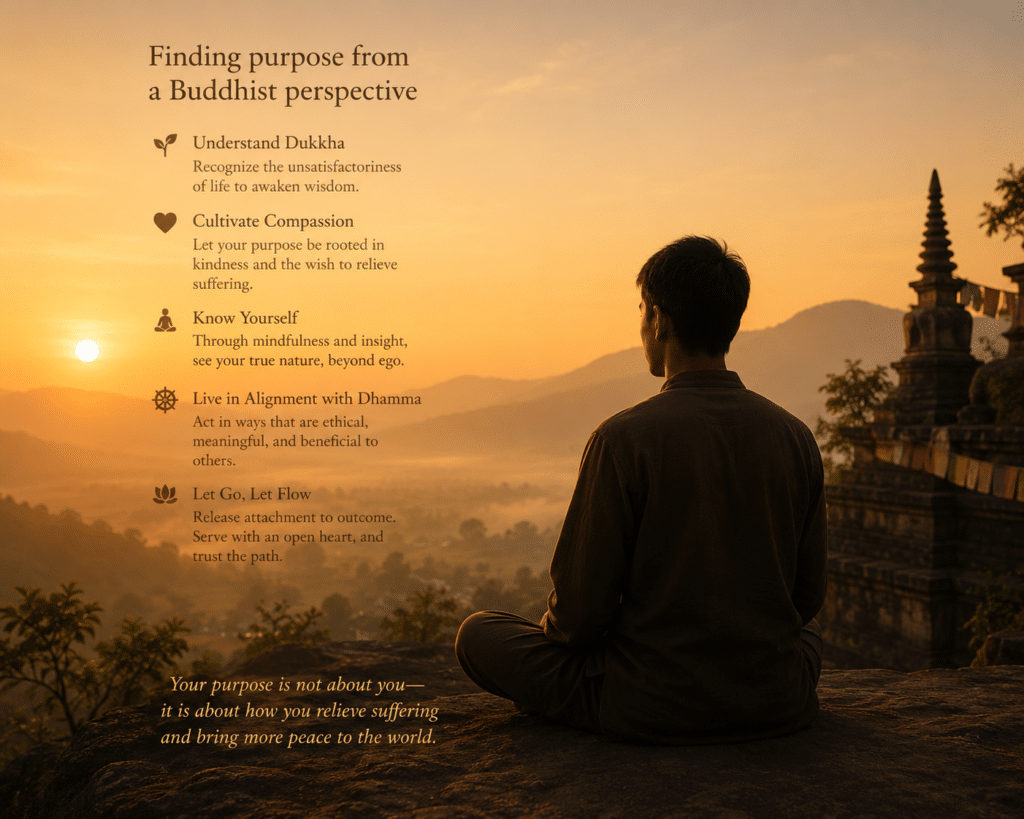
In Buddhism, your purpose is not a destination waiting somewhere in the future.
It is something that gradually reveals itself as your mind becomes calmer, wiser, and more compassionate.
The clearer your mind becomes, the clearer your path becomes.
And perhaps that is the deepest Buddhist answer to finding your purpose.
Buddhism Special Topic Buddhism