Author’s Note
This article is based on my years of studying Buddhist philosophy and my attempt to explain some of its core ideas in a way that is accessible to modern Western readers.
Buddhism is a tradition that spans more than 2,500 years and includes many schools of thought, interpretations, and practices. The ideas presented here are not intended to represent the only or definitive understanding of Buddhism. Rather, they reflect my own synthesis of what I have learned over the years.
You may not agree with every perspective in this article—and that’s perfectly okay.
My goal is not to persuade you to adopt a particular religion or philosophy. Instead, I simply hope to offer another way of thinking about happiness. If these ideas encourage you to reflect more deeply or help you discover your own answers, then this article has fulfilled its purpose.
You don’t have to become a Buddhist to learn from Buddhism. Some of its insights can be valuable regardless of your religious or philosophical beliefs.
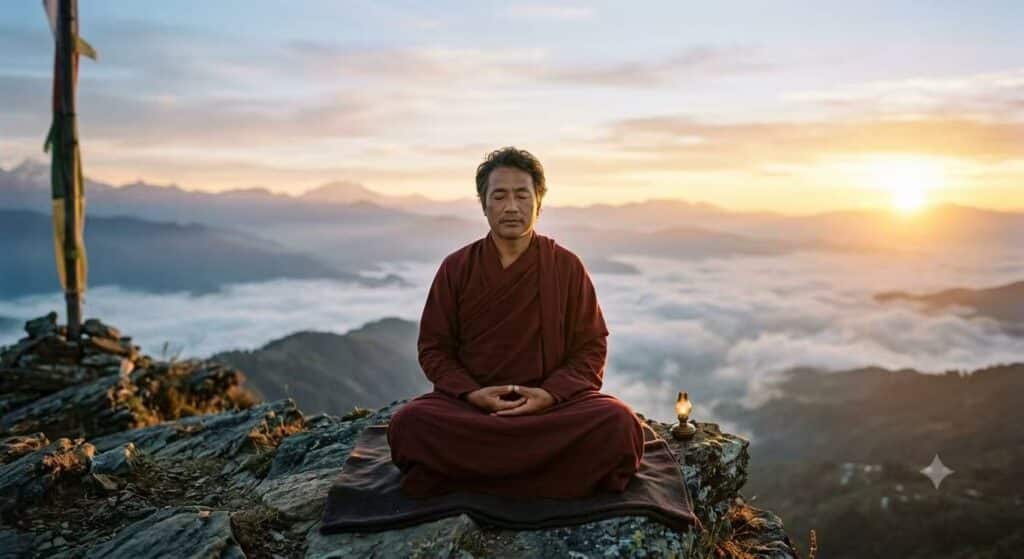
Most of Us Are Chasing the Wrong Kind of Happiness
Almost everyone wants to be happy.
We work hard to build successful careers. We save money for a more comfortable future. We search for meaningful relationships. We hope that the next promotion, the next vacation, or the next achievement will finally bring lasting satisfaction.
Sometimes it does.
For a while.
But eventually the excitement fades. A new goal appears. Another desire takes its place.
Many people spend their entire lives repeating this cycle without ever questioning it.
Buddhism begins with a surprisingly simple observation:
If happiness depends entirely on changing external circumstances, then it can never be truly secure.
This does not mean that wealth, success, or pleasure are bad. Buddhism does not ask us to reject the world or avoid enjoying life.
Instead, it asks a deeper question:
Why does lasting happiness seem so difficult to find, even when we get everything we once wanted?
Why External Success Rarely Feels Complete
Modern culture often tells us that happiness comes from acquiring more.
More money.
More freedom.
More recognition.
More experiences.
More security.
There’s nothing inherently wrong with these pursuits.
The problem is that they rarely satisfy us for very long.
Psychologists sometimes refer to this phenomenon as hedonic adaptation—our tendency to quickly become accustomed to positive changes until they feel ordinary again.
More than two thousand years before modern psychology described this pattern, Buddhism was exploring the same human experience from a different perspective.
It explained this tendency through the concept of Avidyā, often translated as ignorance.
Here, “ignorance” does not mean lacking intelligence or education.
Instead, it means misunderstanding the nature of reality.
We naturally assume that temporary things can provide permanent fulfillment.
But everything changes.
Our careers change.
Our relationships change.
Our health changes.
Our emotions change.
Even our own identities evolve throughout life.
When we expect changing things to provide unchanging happiness, disappointment becomes almost inevitable.
Attachment, Not Possessions, Creates Suffering
If losing something hurts, we often assume that the loss itself caused our suffering.
Buddhism invites us to look one step deeper.
Perhaps suffering does not arise simply because something changed.
Perhaps it arises because we believed it should never change.
This is the idea behind Upādāna, usually translated as attachment or clinging.
Attachment is one of the most misunderstood concepts in Buddhism.
It does not mean we shouldn’t love people.
It does not mean we shouldn’t enjoy beautiful experiences.
It certainly does not mean living without emotion.
Instead, attachment describes our tendency to make our inner peace dependent upon circumstances we cannot ultimately control.
We don’t merely appreciate success.
We become convinced that we must succeed.
We don’t simply enjoy relationships.
We become convinced they must never change.
The tighter we cling, the more anxiety we create.
Ironically, the very things we hope will guarantee happiness often become the source of our deepest fears.
The Self We Protect May Not Be What We Think
One of Buddhism’s most fascinating ideas is Anattā, often translated as non-self.
At first glance, this idea sounds strange—even unsettling.
Does Buddhism really claim that we don’t exist?
Not exactly.
Anattā does not deny our existence as living human beings.
Instead, it questions whether the solid, permanent identity we constantly defend is as fixed as we imagine.
Think about the person you were ten years ago.
Your beliefs have changed.
Your memories have changed.
Your body has changed.
Your priorities have changed.
Even your personality has likely evolved.
Yet we still speak as though there were one completely unchanging “self” moving through all of these experiences.
Buddhism suggests that much of our suffering comes from trying to protect this imagined permanence.
“I must always succeed.”
“I cannot fail.”
“People must respect me.”
“My life should unfold according to my plan.”
The stronger these rigid identities become, the more fragile our happiness becomes.
Real freedom begins not by strengthening the ego, but by loosening our attachment to it.
Happiness Grows Through Letting Go, Not Accumulating More
Modern society often teaches us that improvement means adding something.
A better job.
A larger house.
A stronger reputation.
More achievements.
Buddhism offers a remarkably different perspective.
Instead of asking,
“What else do I need?”
it asks,
“What unnecessary burden can I let go of?”
In this sense, Buddhist practice resembles clearing away clouds rather than creating a new sky.
Peace is not manufactured.
It is uncovered.
As attachment gradually weakens, the mind naturally becomes lighter.
Not because life becomes perfect.
But because we stop demanding that it be perfect.
Wisdom Changes the Meaning of Suffering
One famous Buddhist saying declares:
“Afflictions themselves can become Bodhi.”
In Chinese Buddhism, this teaching is summarized as 烦恼即菩提.
At first, the statement seems almost contradictory.
How could suffering possibly become wisdom?
The answer lies in another important Buddhist concept:
Prajñā, often translated as wisdom.
Prajñā is different from knowledge.
Knowledge gathers information.
Wisdom changes perception.
Every disappointment reveals an expectation.
Every anger reveals an attachment.
Every fear reveals something we are trying desperately to hold onto.
Instead of treating suffering as meaningless punishment, Buddhism encourages us to treat it as information.
Pain becomes a mirror.
Instead of asking,
“Why is this happening to me?”
we begin asking,
“What is this experience teaching me about my own mind?”
This shift alone can completely transform how we experience hardship.
The Three Poisons That Disturb the Mind
According to Buddhism, much of human suffering grows from what are called the Three Poisons.
They are:
Greed (Lobha) — the endless craving for more.
Hatred (Dosa) — anger, resentment, and resistance toward reality.
Delusion (Moha) — seeing ourselves and the world through misunderstanding rather than clarity.
These are not considered moral failures.
They are mental habits.
When these habits dominate the mind, peace becomes difficult.
When they gradually weaken through mindfulness, ethical living, compassion, and wisdom, happiness begins to arise naturally.
Not because the world has changed.
Because the mind has.
Nirvāṇa: Happiness Beyond Circumstances
Few Buddhist ideas are more misunderstood than Nirvāṇa.
Many people imagine it as a mystical heaven or a supernatural destination reached after death.
Traditionally, however, Nirvāṇa refers to the extinguishing of greed, hatred, and delusion.
It is not endless excitement.
It is not constant pleasure.
It is not emotional numbness either.
It is profound inner freedom.
Imagine standing beside the ocean during a storm.
The surface is turbulent.
The waves crash against one another.
But deep beneath the surface, the water remains remarkably still.
Buddhism suggests that the human mind can become like that ocean.
Life’s circumstances may continue to change.
Success and failure will still come and go.
Joy and sorrow will continue to appear.
But beneath those changing experiences, a deeper peace becomes possible.
This peace does not depend on controlling the world.
It comes from no longer being controlled by it.
A Different Definition of Happiness
Most of us spend our lives trying to change the world so that we can finally become happy.
Buddhism gently turns that assumption upside down.
Perhaps lasting happiness is not the reward for getting everything we want.
Perhaps it is the freedom that appears when we no longer require life to unfold exactly as we expect.
From a Buddhist perspective, happiness grows not through possession, but through understanding.
Not through control, but through acceptance.
Not through endless acquisition, but through wise letting go.
The world will continue to change.
People will continue to come and go.
Success will rise and fall.
That is simply the nature of life.
The question is whether our peace must rise and fall with it.
Perhaps Buddhism’s greatest insight is this:
Real happiness is not found by changing the world around us. It is found by transforming the way we experience the world within us.
Buddhism Special Topic Buddhism