In a world filled with uncertainty, pressure, and constant change, it is easy to feel that our peace depends on circumstances we cannot control. We chase success, approval, security, relationships, and certainty, hoping that something outside of us will finally make us feel free.
Buddhist philosophy offers a different approach.
It does not teach us to escape from life or withdraw from the world. Instead, it asks us to look directly at the mind and understand why we suffer in the first place. Through awareness, wisdom, and the gradual release of attachment, we can become less controlled by our thoughts, emotions, and circumstances.
From a Buddhist perspective, inner freedom does not mean creating a life without difficulties. It means developing a mind that is no longer completely controlled by difficulties.
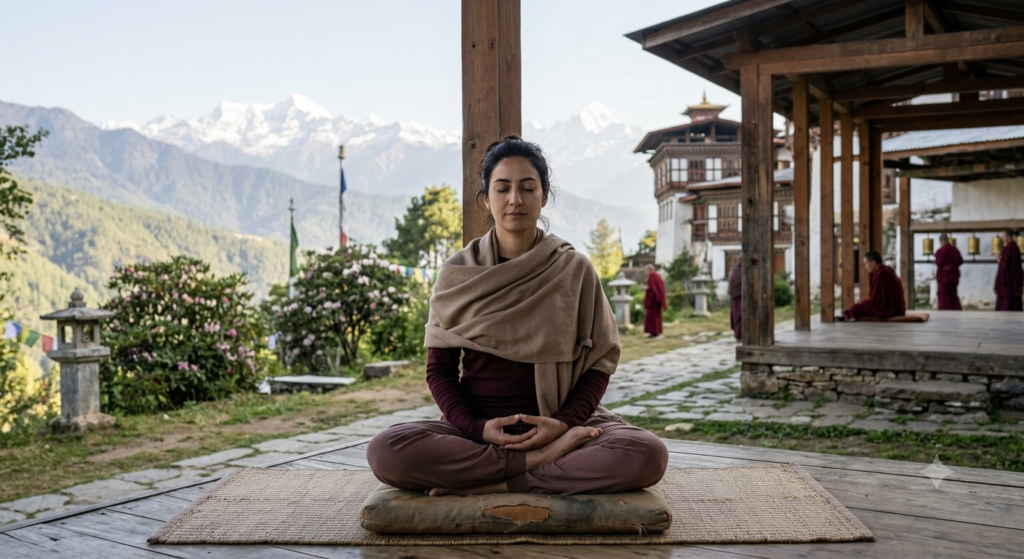
1.Understand Dukkha and Attachment: Release the Weight You Carry
One of the first steps toward inner freedom is recognizing dukkha, a central Buddhist concept often translated as “suffering,” “stress,” or “unsatisfactoriness.”
Dukkha does not simply mean that life is miserable. It points to a deeper problem: everything in life is constantly changing, yet we often expect changing things to give us permanent security.
We become attached to our careers, relationships, social status, possessions, identities, and expectations about the future. We may even become attached to the idea that life should unfold according to our plans.
This attachment, or upādāna, creates a subtle form of psychological pressure.
We want success to remain permanent.
We want relationships never to change.
We want people to see us in a certain way.
We want the future to be predictable.
We want to control what cannot ultimately be controlled.
The more tightly we hold on, the more afraid we become of losing what we have.
Buddhist philosophy invites us to observe this process rather than immediately trying to satisfy every desire. We begin to recognize that external achievements can provide temporary pleasure or security, but they cannot guarantee permanent inner peace.
This does not mean abandoning ambition or relationships. It means changing our relationship with them.
We can participate fully in life without demanding that life give us permanent security.
When we begin to loosen our attachment, the mind has more space to breathe.
That is the beginning of inner freedom.
2.Move Beyond Intellectual Understanding: From Knowing to Direct Experience
Another obstacle on the path is confusing intellectual knowledge with genuine transformation.
A person can read Buddhist scriptures, memorize the Four Noble Truths, study dependent origination, and understand sophisticated Buddhist philosophy—yet still become overwhelmed by anger, fear, jealousy, or anxiety when life becomes difficult.
Knowing the map is not the same as walking the path.
Buddhist traditions repeatedly emphasize the importance of direct experience. Wisdom is not merely something we collect as information. It must gradually become something we see for ourselves.
This is why Buddhist practice places such importance on mindfulness, meditation, ethical conduct, and observation of the mind.
For example, it is easy to understand intellectually that anger is temporary. It is much harder to observe anger while it is actually arising and recognize:
“This is anger. It is present in my mind, but it does not have to control my actions.”
That small moment of awareness creates distance between consciousness and reaction.
Some Mahayana Buddhist traditions also speak of Buddha-nature, the potential for awakening that is said to be present within sentient beings. In this context, awakening is not simply the acquisition of more concepts. It is a process of seeing through the patterns that obscure wisdom.
The goal is therefore not to become someone who knows more about Buddhism.
It is to become someone who sees more clearly.
3.Cultivate Prajñā: Let Awareness Transform Your Relationship with Suffering
True inner freedom does not require eliminating every uncomfortable thought or emotion.
Fear may still arise.
Desire may still arise.
Anger, sadness, insecurity, and anxiety may still arise.
The difference is that we no longer have to be completely carried away by them.
This is where prajñā, or Buddhist wisdom, becomes important.
Prajñā is not simply intellectual intelligence. It is a deeper insight into the nature of experience—especially impermanence, suffering, and emptiness (śūnyatā).
When a difficult emotion arises, we can practice observing it rather than immediately identifying with it.
Instead of:
“I am anxious.”
we can begin to notice:
“Anxiety is arising in the mind.”
The distinction may seem small, but it changes our relationship with the experience.
The emotion is still present, but we are no longer completely fused with it.
This is closely related to the Buddhist idea of mindfulness (sati): seeing what is happening in the present moment without immediately being driven by it.
The Heart Sutra famously speaks of “seeing the emptiness of the five aggregates.” The teaching is not that our experiences simply do not exist. Rather, it points toward the insight that our thoughts, emotions, identities, and experiences do not possess the permanent, independent solidity we often imagine.
From this perspective, awareness becomes a kind of sword of wisdom.
It cuts through the assumption that every thought must be believed, every emotion must be acted upon, and every desire must be fulfilled.
This is one way to understand the Mahayana expression “烦恼即菩提” (afflictions can become the path to awakening).
Our difficulties do not have to be obstacles to spiritual growth.
They can become the very material through which wisdom develops.
Anger can reveal attachment.
Fear can reveal our demand for certainty.
Jealousy can reveal insecurity.
Anxiety can reveal our attempt to control the future.
When we observe these states clearly, suffering itself can become a teacher.
4.Use Adversity as Practice: Discover Freedom When Life Does Not Go Your Way
Most people naturally think of adversity as the enemy of freedom.
If we had more money, better relationships, greater social recognition, better health, or more control over our circumstances, we imagine that we would finally feel secure.
But Buddhist philosophy invites us to examine this assumption.
What happens when the external conditions we depend on suddenly disappear?
When approval disappears, who are we?
When certainty disappears, can we remain calm?
When our plans fail, can we still remain present?
When circumstances become uncomfortable, can we observe the mind without immediately reacting?
This is why adversity can become a powerful form of spiritual practice.
When the things we normally rely upon are taken away, we are sometimes forced to look inward.
This does not mean that suffering is automatically good or that we should seek out hardship. Buddhism does not require us to romanticize pain.
Rather, difficult circumstances can reveal the places where we are most attached.
A crisis may show us how strongly we depend on control.
A rejection may reveal how much our identity depends on other people’s approval.
An unexpected change may reveal how deeply we resist impermanence.
In this sense, adversity becomes a mirror.
Instead of asking only:
“How can I make this situation go away?”
we can also ask:
“What is this situation revealing about my mind?”
That question changes the direction of practice.
We are no longer trying to control every external condition before allowing ourselves to be at peace.
We are learning how to remain inwardly steady while conditions change.
This is close to the Buddhist ideal of equanimity (upekkhā)—a balanced mind that is not constantly pulled between attraction and aversion.
5.Inner Freedom Is Not Escape—It Is Non-Attachment
Buddhist freedom is sometimes misunderstood as withdrawing from ordinary life.
But inner freedom does not necessarily mean leaving society, abandoning relationships, or giving up worldly responsibilities.
It means becoming less psychologically dependent on them.
You can enjoy success without believing that success defines your worth.
You can love another person without demanding that they permanently fulfill all your emotional needs.
You can pursue a goal without believing that achieving it will finally complete you.
You can experience failure without concluding that you are a failure.
You can experience uncertainty without requiring an immediate answer.
This is the difference between attachment and participation.
Attachment says:
“This must happen for me to be okay.”
Non-attachment says:
“I deeply care about this, but my entire inner stability does not depend on the outcome.”
That is a much deeper form of freedom.
Conclusion: Freedom Begins When the Mind No Longer Needs the World to Be Perfect
Buddhist philosophy does not promise a life without uncertainty, loss, disappointment, or difficult emotions.
Instead, it offers a different possibility: a mind that can remain aware in the middle of uncertainty.
We begin by recognizing dukkha and the role of attachment.
We move beyond merely understanding Buddhist teachings intellectually and begin to experience them directly.
We cultivate mindfulness and prajñā, learning to observe thoughts and emotions without automatically becoming their servants.
We use adversity as an opportunity to see our attachments more clearly.
And gradually, we develop equanimity—the ability to remain inwardly balanced while the external world continues to change.
The deepest form of freedom is therefore not the ability to control everything around us.
It is the ability to remain free within ourselves even when life does not go according to our wishes.
Inner freedom begins when we stop demanding that the world become perfectly stable before we allow the mind to become peaceful.
In Buddhist practice, this freedom is not something we acquire from outside.
It is something we gradually uncover through awareness, wisdom, and the letting go of attachment.
Buddhism Special Topic Buddhism