Main Thesis
The debate about whether consciousness is produced by the brain may be fundamentally misplaced — because in direct experience, the brain is never encountered, only consciousness itself and its contents are experienced.
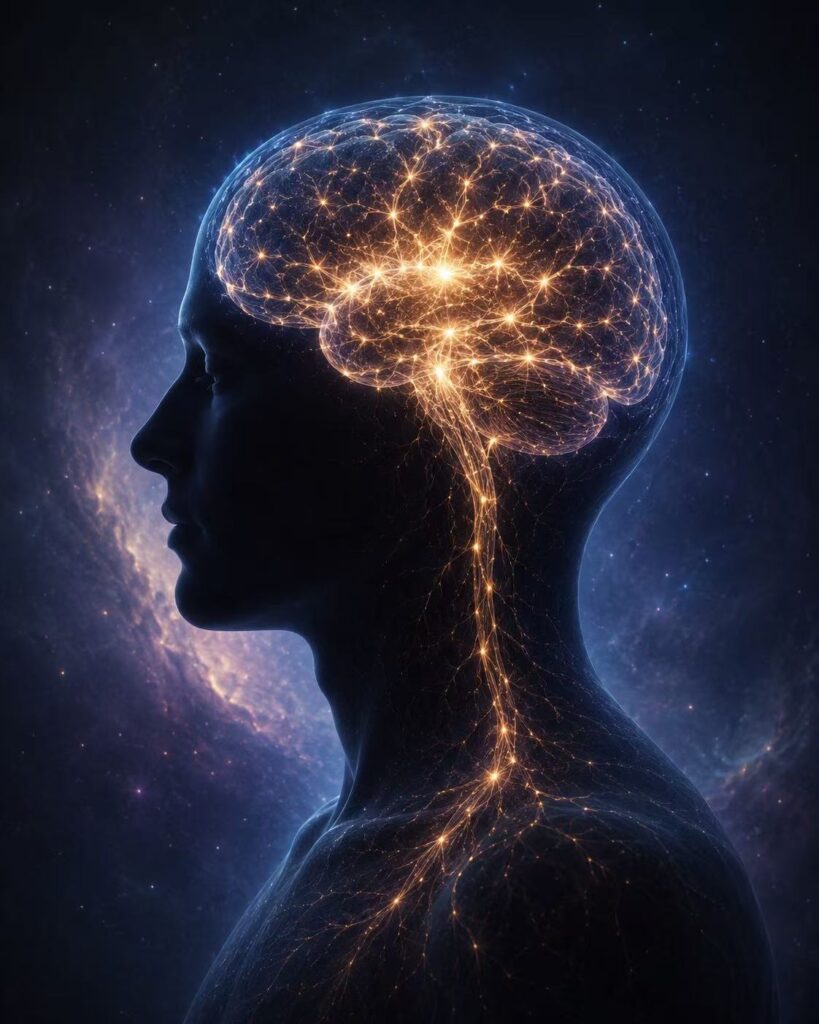
For decades, the dominant scientific view has been clear:
Consciousness is generated by the brain.
Neuroscience strongly supports this correlation. Changes in brain activity alter perception, thought, and identity. Anesthesia can shut consciousness down. Brain injuries can modify personality and awareness.
From this perspective, consciousness appears to depend entirely on neural processes.
However, an alternative view has repeatedly emerged in philosophy, meditation traditions, and modern discussions of consciousness:
What if the brain is not producing consciousness, but only associated with it?
Some propose that the brain functions like a receiver, similar to a radio tuning into a signal. Others suggest consciousness may be more fundamental than matter itself — a field rather than a product.
These interpretations seem contradictory, but both often miss a more direct question.
The Key Question Rarely Asked
Instead of asking whether the brain produces consciousness, consider this:
In your direct experience, have you ever actually encountered your brain?
Not as a scientific model. Not as an MRI scan. Not as an abstract belief.
But as immediate experience itself.
What is directly present is only:
- thoughts
- sensations
- perceptions
- emotions
Nowhere in this immediate field of experience is there a directly perceived “brain producing experience.”
The brain is always inferred, never directly experienced.
This creates a structural gap:
The brain exists as explanation, not as experience.
Two Levels of Understanding
This leads to two fundamentally different frameworks.
1.Third-Person Model (Neuroscience)
From the scientific perspective:
- Brain activity correlates with consciousness
- Neural processes generate experience
- Consciousness depends on biological function
This model is powerful for prediction and explanation, but it remains external. It describes consciousness from the outside.
2.First-Person Experience (Direct Awareness)
From direct experience:
- Only awareness is present
- Thoughts and sensations arise within awareness
- Even the concept of “brain activity” appears as a thought within experience
In this view, consciousness is not located inside the brain.
Instead, it is the field in which all experience appears.
Structural Reversal of the Model
This creates a reversal:
Science claims:
This creates a persistent gap between:
Brain → produces consciousness
But in direct experience:
Consciousness → contains the idea of the brain
The brain is never encountered directly; it is inferred within experience.
This does not invalidate neuroscience. It separates two domains that are often confused:
- explanatory models
- direct experience
Why This Question Feels Unresolved
The tension persists because both frameworks operate at different levels.
If consciousness is purely brain-generated, subjective experience must be fully reducible to physical processes.
But in direct observation, physical processes are never experienced as such — only their mental representations appear.
- explanation
- experience
And that gap remains central to the study of consciousness.
What Is the Real Question?
The disagreement may not be about whether consciousness is physical or non-physical.
A deeper question may be:
Why does experience appear in a form where a “brain” must be inferred at all?
Because everything known — including science, the brain, and this discussion — appears within consciousness itself.
Final Insight
The debate between neuroscience and alternative theories of consciousness may ultimately point to a different direction:
Not a final answer about what consciousness is,
but an inquiry into how experience is structured in the first place.
And once this shift occurs, the question changes again:
Not where consciousness comes from,
but:
What is it that is aware of this question right now?
Next Article
Why Does the Universe Exist? A Philosophy of Constraint, Energy, and Meaning
What Is the Meaning of Life? An Eastern Philosophy Guide to Humanity’s Greatest Question Meaning of Life