Main idea
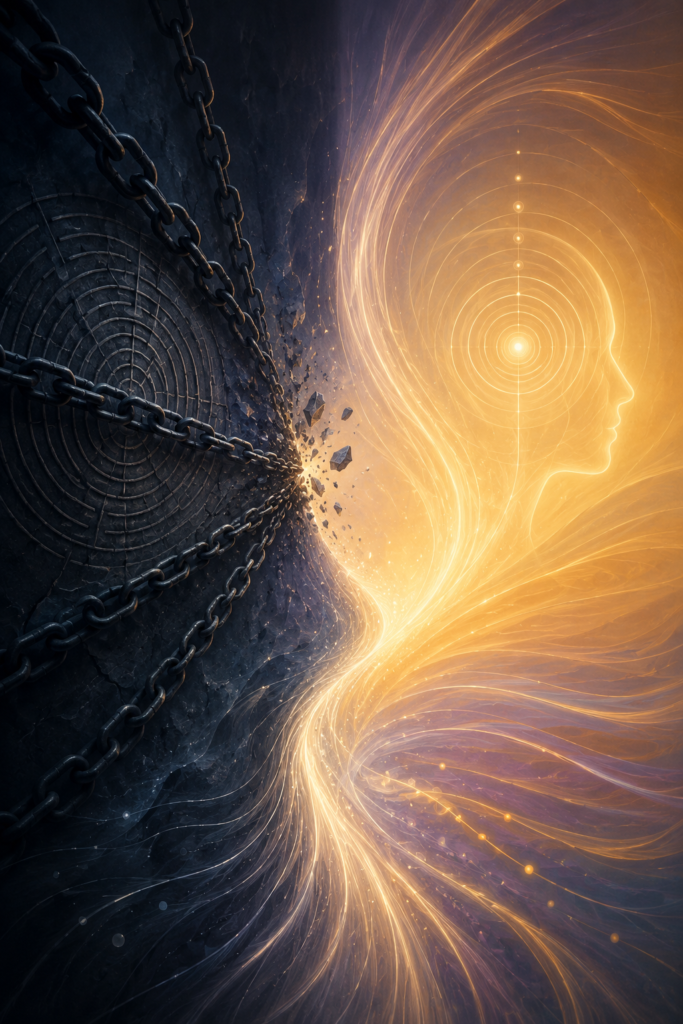
This article argues that the universe may originate from a fundamental state of “constraint” or extreme compression, and that existence itself emerges as a process of release, transformation, and self-organization. From an Eastern philosophical perspective, this cosmic structure is mirrored in human life: the feeling of being “trapped” is not an exception but a reflection of how reality itself operates. Meaning, therefore, is not something found externally, but something generated through the transformation of inner energy, awareness, and creative engagement with constraint.
Introduction: An Eastern Philosophical Lens on the Universe
This article uses an Eastern philosophical framework to interpret one of the most fundamental questions in science and philosophy:
Why does the universe exist at all?
Instead of treating the universe as a purely mechanical system or a random accident, this perspective views existence as a dynamic process of emergence from constraint, tension, and transformation.
In this view, the universe is not just something that “happened.”
It is something that is continuously unfolding.
1.The Universe Begins in a State of Constraint
Modern cosmology describes the origin of the universe as a highly compressed initial state, often referred to as a singularity. From this condition, space, time, and matter emerged through expansion.
From an Eastern philosophical interpretation, this can be understood more metaphorically:
Existence begins in a state of extreme constraint.
Constraint here does not mean limitation in a negative sense, but a condition of maximum density, tension, and potential energy—a state where nothing is yet differentiated, but everything is already contained.
In this sense, the universe does not begin with “empty space,” but with total compression of possibility.
2.Space and Time as a Mechanism of Release
If the initial state of existence is one of extreme constraint, then space and time can be interpreted as a release mechanism.
Rather than being passive backgrounds, they function as structures that allow:
- Separation of matter
- Movement and change
- The unfolding of complexity
- The transition from potential to form
In this interpretation, the Big Bang is not only an explosion outward, but also a structural unfolding of what was previously condensed.
Existence, then, is not static—it is a continuous process of unfolding tension.
3.The Universe as a Cycle of Order and Disorder
Physics describes the universe through thermodynamic principles, especially entropy. Over time, systems tend to move from order toward disorder, while local pockets of order still emerge.
From this perspective, the universe can be understood as a dynamic oscillation:
- Formation and dissolution
- Aggregation and dispersion
- Structure and decay
Rather than a one-time creation event, existence resembles a cosmic breathing process—expansion followed by scattering, order followed by entropy.
This suggests that instability is not a flaw in the universe. It is its fundamental rhythm.
4.Human Life as a Reflection of Cosmic Structure
From this perspective, human experience is not separate from cosmic logic—it mirrors it.
The feeling of being “trapped,” pressured, or constrained is not an anomaly. It reflects a deeper structural truth:
Life emerges from the same principle of constraint that defines the universe itself.
This does not mean suffering is meaningless, but that it is structurally embedded in existence, rather than being a personal failure or deviation.
Understanding this shifts the psychological interpretation of struggle:
- Difficulty is not a sign that something is wrong
- Constraint is not an exception to life—it is its condition
5.Meaning Is Not Found, but Generated Through Energy Transformation
If the universe operates through cycles of constraint and release, then human life operates in the same way.
Meaning, therefore, is not something externally given. It is something that emerges when internal energy is transformed.
This leads to a key conclusion:
The purpose of life is not to eliminate constraint, but to transform it.
This transformation can take many forms:
- Creativity
- Awareness
- Curiosity
- Emotional clarity
- Engagement with experience rather than resistance to it
From this perspective, joy is not the absence of pressure, but a change in the flow of energy within constraint.
6.The Eastern Perspective: Harmony Within the Flow
In Eastern philosophy, especially Taoist thinking, reality is not viewed as a system to be controlled, but as a process to be aligned with.
The universe is not a problem to be solved—it is a movement to be understood.
In this framework:
- Struggle is not rejected
- Constraint is not denied
- Change is not resisted
Instead, the emphasis is on alignment with the underlying flow of existence.
Meaning arises when a person stops fighting the structure of reality and begins to move with it intelligently and consciously.
Conclusion: Why the Universe Exists in This Interpretation
From this perspective, the question “Why does the universe exist?” does not have a single mechanical answer.
Instead, existence can be understood as:
A continuous process in which constraint becomes structure, structure becomes experience, and experience becomes awareness.
And human life is not outside this process—it is one of its most sensitive expressions.
In this sense, the universe does not exist for a purpose we can point to externally.
It exists as an unfolding process in which meaning is continuously generated from within.
Next Article
Are We Alone in the Universe? And Why Does the Question Matter?
What Is the Meaning of Life? An Eastern Philosophy Guide to Humanity’s Greatest Question Meaning of Life