Why do we keep searching for meaning, even when life seems to offer no final answers?
Why do people who have wealth, success, relationships, and social status still feel empty inside?
Why can someone be surrounded by family and friends, yet suddenly wonder, “What is the point of all this?”
If everything we build will eventually disappear, what gives our lives lasting significance?
Why do we continue striving, loving, suffering, and hoping if one day we will die?
If suffering is unavoidable, can it reveal something essential?
If God no longer tells us what is true, what makes our choices meaningful?
If meaning is something we create ourselves, why should we believe it is real?
How can values we invent carry any genuine weight?
What gives our lives staying power in a universe that offers no guarantees?
Is meaning something hidden in the universe, waiting to be discovered?
Or is it something we must forge through the way we live?
These questions have followed humanity for thousands of years.
We created religion, philosophy, science, art, and stories in an attempt to answer the same fundamental question:
What is the meaning of life?
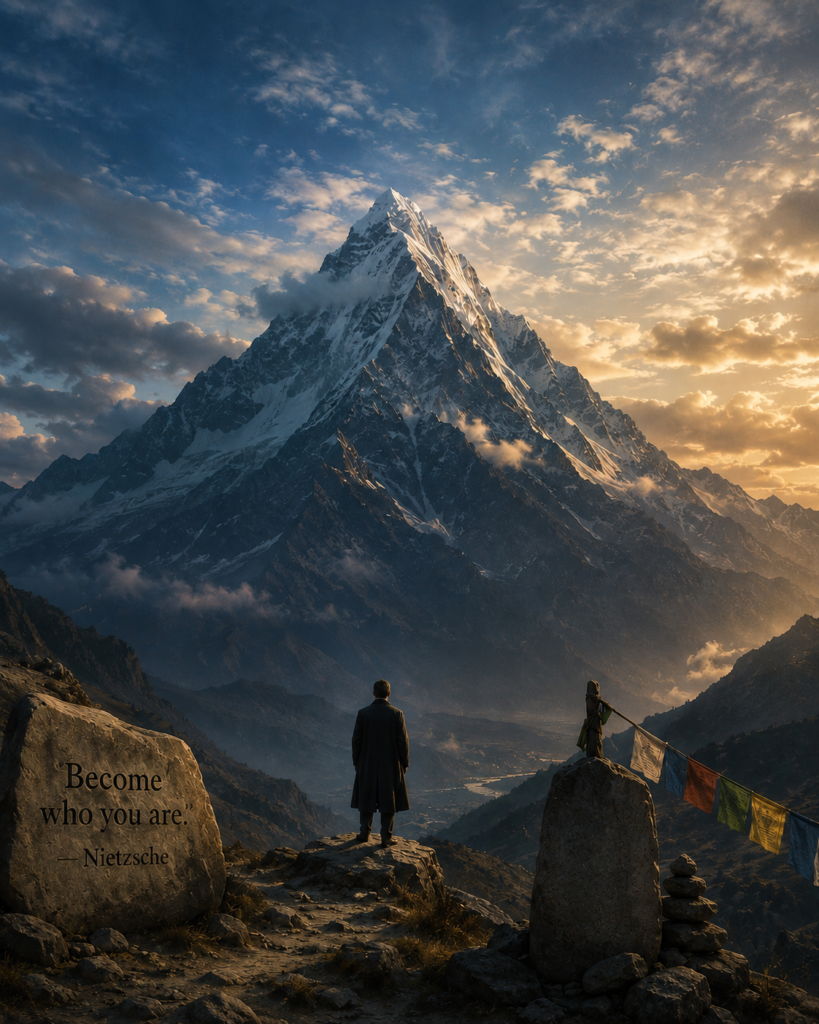
This article offers an Eastern philosophical interpretation of Friedrich Nietzsche’s answer to that question.
Western philosophy often approaches this question through logic and argument. Eastern philosophy often approaches it through lived experience, inner transformation, and harmony with the deeper movement of life.
Seen through this Eastern lens, Nietzsche’s message becomes surprisingly clear:
Life does not come with a prewritten meaning. Meaning emerges as you grow, transform, and create who you are.
Human beings have always searched for meaning. We created religion, philosophy, science, art, and stories to answer the same fundamental question: Why are we here?
For many people, meaning once came from God. To follow divine commandments was to feel aligned with the structure of the universe itself. Your actions were rooted in eternal truth. Your suffering had purpose. Your life had direction. Your soul could rest.
But Nietzsche shattered this inherited certainty.
He declared that the old foundations were collapsing. Traditional beliefs were losing their unquestioned authority. The world no longer came with a guaranteed script.
And this raises one of the deepest questions a human being can ask:
If there is no God to tell us what is true, why should we believe that the values we choose are real?
This is not a small philosophical puzzle. It is the hidden anxiety of modern life.
If meaning is something we invent ourselves, what gives it weight? What gives it staying power? What makes it more than a comforting illusion?
Nietzsche’s answer is radical:
The meaning of life is not something you find. It is something you become.
The Mountain: Facing Yourself
In many Eastern traditions, wisdom begins when a person becomes still.
Like a mountain, you stop running from yourself.
You sit quietly and ask:
- Who am I without society’s expectations?
- What do I truly value?
- What kind of life feels worthy to me?
Nietzsche believed that most people inherit their beliefs from religion, culture, and social pressure. But a meaningful life begins when you question those inherited answers.
Before you can create your path, you must first face your own nature.
The Wind: Transformation Happens Slowly
Eastern philosophy teaches that the deepest changes are often invisible.
The wind cannot be seen, but over time it reshapes forests, deserts, and oceans.
Meaning develops in the same way.
It rarely arrives in a dramatic revelation. Instead, it forms gradually through:
- difficult choices,
- repeated effort,
- honest reflection,
- and the courage to live according to your values.
Nietzsche did not believe that purpose is discovered like hidden treasure.
He believed it is cultivated, like a garden.
The Empty Space: Freedom After Old Beliefs Collapse
Both Eastern thought and Nietzsche recognize that emptiness is not necessarily a problem.
When old beliefs fall away, life can feel uncertain. This can be frightening.
But emptiness also creates space.
In Buddhism, emptiness means that things are not fixed. In Nietzsche’s philosophy, the collapse of old certainties gives human beings the freedom to create new values.
What first feels like a void can become an open field.
The universe may never hand you a final answer.
But that is not a tragedy. It is an invitation.
The Creative Self
Nietzsche’s ideal human being is someone who does not wait for the universe to provide instructions.
Instead, they ask:
- What do I love deeply?
- What am I willing to struggle for?
- What kind of person do I choose to become?
This is not selfishness.
It is responsibility.
In Eastern terms, it is the discipline of shaping one’s own character.
In Nietzsche’s terms, it is self-overcoming.
When someone cuts you off in traffic, you do not refrain from anger because a sacred book commands you to.
You refrain because you choose dignity over pettiness.
You choose strength over reaction.
You choose to become the kind of person you respect.
This is what it means to create your own values.
Not to invent arbitrary rules, but to shape a life that you can wholeheartedly affirm.
The Role of Suffering
Eastern philosophy often teaches that suffering can awaken wisdom.
Nietzsche agreed.
Pain is not proof that life lacks meaning.
More often, it is the fire that reveals what matters most.
A meaningful life is not one without hardship.
It is one in which hardship becomes part of your growth.
Suffering strips away illusions.
It forces you to discover what is essential.
And in that discovery, your values become real.
Becoming Like the Sky
The highest Eastern symbol is often the open sky: vast, creative, and unconstrained.
Nietzsche envisioned a human being who lives in this way:
- grounded in reality,
- free from borrowed beliefs,
- and capable of creating new values.
Such a person does not merely survive.
They actively shape the meaning of their life.
They no longer ask whether the universe approves.
They ask only whether they can say yes to the life they are living.
Nietzsche’s Answer to the Meaning of Life
Viewed through Eastern philosophy, Nietzsche’s answer is:
The meaning of life is not something you find. It is something you become.
You become it:
- by facing yourself honestly,
- by letting old illusions fall away,
- by transforming suffering into strength,
- and by creating a life that you can wholeheartedly affirm.
Meaning is not guaranteed by the universe.
Meaning is forged through the way you live.
Final Reflection
The universe may never hand you a final answer.
But that is not a tragedy.
It is an invitation.
Like a mountain, become still.
Like the wind, transform gradually.
Like the open sky, create without limit.
And in that process, the meaning of life quietly unfolds.
Yet even after we begin creating our own values, another question quietly remains:
Why do so many people in the modern world still feel empty?
Why does freedom sometimes lead not to fulfillment, but to loneliness, anxiety, and exhaustion?
Perhaps the problem is not only the loss of old beliefs, but the deeper condition of modern life itself.
This is the question we will explore next through an Eastern philosophical interpretation of Albert Camus and the modern search for meaning.Why Modern Life Still Feels Empty — An Eastern Philosophical Interpretation of Albert Camus and the Meaning of Life
What Is the Meaning of Life? An Eastern Philosophy Guide to Humanity’s Greatest Question-Meaning of Life