What happens when life becomes almost unbearable?
What can Buddhism say to someone living through genocide, child abuse, torture, or extreme poverty? What comfort is there for a person who cannot meet even their most basic needs? If suffering is caused by cruelty, injustice, and circumstances far beyond one’s control, how can teachings about attachment and craving possibly help?
This is one of the most serious questions anyone can ask about Buddhism.
And it is exactly the kind of question many people on Reddit have raised.
One redditor put it this way:
“I’ve been wondering how those enduring extreme and prolonged suffering such as genocides, child abuse, torture, and extreme poverty can benefit from Buddha’s teachings.”
This question goes straight to the heart of the issue.
A Failure of Other People’s Ethics
Some suffering is caused by our own desires and attachments.
But some suffering is caused by other people’s actions.
War, abuse, oppression, and exploitation are not created by the victim’s mind. They are failures of ethics, compassion, and justice.
Buddhism fully acknowledges this.
It does not blame victims for their suffering.
It does not suggest that terrible events are acceptable.
And it does not ask people to pretend that pain is not real.
Instead, Buddhism asks a different question:
If you cannot control what other people do, is there still a way to reduce your own inner suffering?
This is where Buddhist practice begins.
The Two Layers of Suffering
This includes hunger, illness, grief, trauma, aging, and death.
The second is the mind’s reaction to pain.
Fear. Hatred. Despair. Resistance. Obsessive thoughts about how life “should” have been.
The Buddha taught that while we cannot always stop the first kind of suffering, we can transform the second.
This insight is expressed in the Four Noble Truths.
- Suffering exists.
- Suffering has causes.
- Suffering can cease.
- There is a path that leads to its cessation.
Buddhism as an Inner Technology
Buddhism can be understood as a practical method for training the mind.
It does not magically remove external problems.
It changes the way the mind processes them.
Through meditation, mindfulness, ethical living, and wisdom, a person learns to:
- Calm racing thoughts
- Observe emotions without being consumed by them
- Reduce hatred and resentment
- Let go of destructive attachment
- Develop compassion and resilience
In modern terms, Buddhism functions like a highly refined system of emotional and cognitive training.
What Buddhism Can and Cannot Do
Buddhism cannot guarantee:
- That you will never get sick
- That you will never lose someone you love
- That injustice will disappear
- That poverty will end overnight
It cannot directly cure every disease or solve every social problem.
But Buddhism can help you:
- Reduce mental suffering
- Face reality more clearly
- Develop inner stability
- Respond with wisdom instead of panic
- Find peace even in difficult circumstances
In this sense, Buddhism is not a magic solution.
It is a disciplined practice.
The Ultimate Goal: Nirvana
At the deepest level, Buddhism teaches that suffering can be ended completely.
By following the Noble Eightfold Path and uprooting craving and ignorance, a practitioner may attain Nirvana.
Nirvana is not a temporary mood.
It is the complete cessation of the mental forces that generate suffering.
This is the ultimate goal of Buddhism.
So, Does Buddhism Solve Suffering?
If you mean:
“Will Buddhism remove all pain and injustice from the world?”
No.
If you mean:
“Can Buddhism help people transform their relationship to pain and eventually attain complete inner liberation?”
Yes.
That is precisely what Buddhism is designed to do.
Final Thought
Buddhism does not promise a life without hardship.
It offers something deeper.
The possibility that even when the world remains imperfect, the mind can become free.
And perhaps that is the most profound answer any philosophy or religion can offer.
Buddhism does not eliminate all suffering. It teaches us how to stop becoming its prisoner.
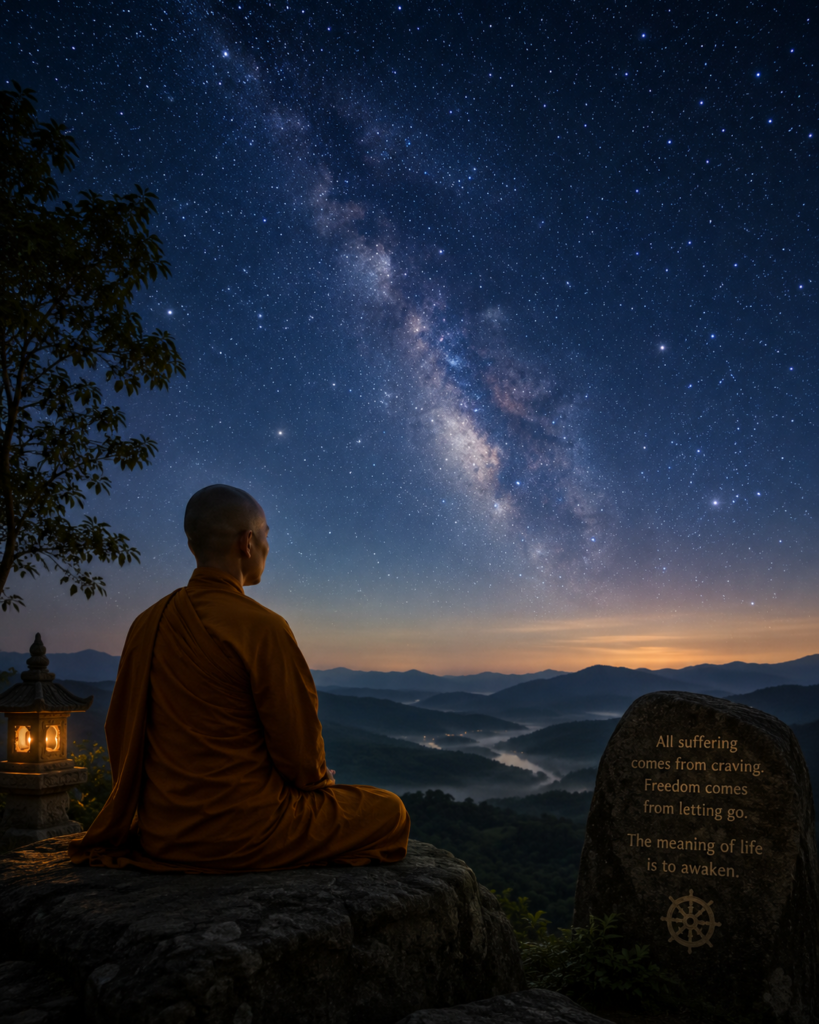
Yet Buddhism is not the only tradition to confront suffering and ask what makes life meaningful. In the modern West, Friedrich Nietzsche wrestled with many of the same questions. If there is no fixed purpose given by the universe, how should we live? Can suffering become a source of strength rather than despair? And is meaning something we discover, or something we create? In the next article, Nietzsche and the Meaning of Life: An Eastern Interpretation, we will explore how one of the most influential Western philosophers approached these questions—and how his ideas can be understood through the lens of Eastern wisdom.
What Is the Meaning of Life? An Eastern Philosophy Guide to Humanity’s Greatest Question