For as long as human beings have been able to look up at the stars, sit beside a funeral fire, hold a newborn child, or lie awake in the quiet of the night, one question has returned again and again:
Why are we here?
Why do we love, suffer, hope, and eventually die?
Is life simply a brief accident in a vast universe?
Are we here to serve God, awaken from illusion, repair the world, or live in harmony with nature?
Is there a purpose hidden beneath our struggles, or must we create meaning for ourselves?
Across civilizations, people have answered these questions in remarkably different ways.
In the West, religious traditions often emphasize a relationship with a personal God, moral responsibility, and the hope of salvation.
In the East, many spiritual traditions focus on inner awakening, harmony with the cosmos, liberation from attachment, and the realization that the self is deeply connected to a greater reality.
This article draws especially on insights from Eastern philosophy while also comparing the major religious traditions of the world. Rather than arguing that any one answer is universally correct, it offers a respectful overview of how different cultures have tried to understand one of humanity’s oldest and most profound questions:
What is the meaning of life?
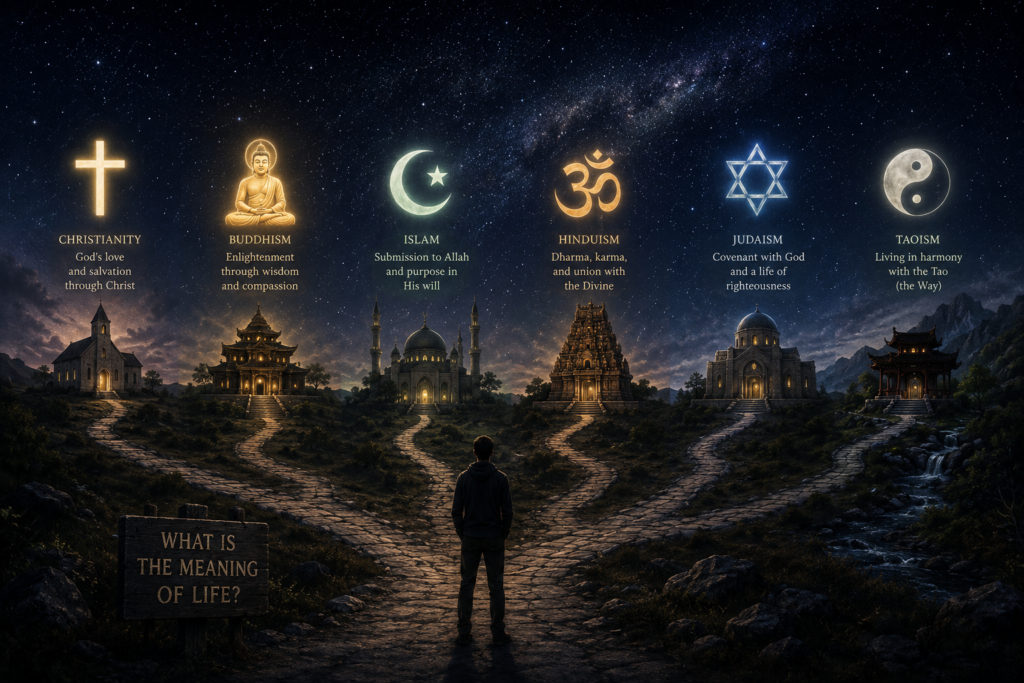
Christianity: To Know, Love, and Glorify God
Many Christians believe that the meaning of life is to know God, love Him, and live in loving relationship with others.
According to Christian teaching, human beings are created in the image of God and are called to reflect His love through compassion, forgiveness, and service. Faith in Jesus Christ is understood as the path to reconciliation with God and the promise of eternal life.
For many Christians, life is ultimately about glorifying God and finding lasting peace in His presence.
Buddhism: To Awaken and Become Free from Suffering
Buddhism begins with the observation that life includes suffering, impermanence, and change.
Buddhist teachings suggest that much of human suffering arises from attachment and misunderstanding. Through ethical living, meditation, and wisdom, practitioners seek awakening and inner freedom.
The ultimate goal is Nirvana, a state beyond suffering and compulsive craving. In many Buddhist traditions, compassion for all beings is also central to a meaningful life.
Islam: To Worship Allah and Live Righteously
Muslims generally understand the purpose of life as worshipping Allah and living according to His guidance.
This includes prayer, charity, fasting, pilgrimage, and daily acts of honesty, justice, and compassion. Human life is seen as a trust and a test, with moral choices carrying significance in both this world and the hereafter.
For many Muslims, meaning is found in submission to God and service to others.
Hinduism: To Realize the True Self and Attain Liberation
Hindu traditions offer a rich and diverse understanding of life’s purpose.
A common teaching is that human life involves four aims: Dharma (duty and righteousness), Artha (prosperity), Kama (pleasure and fulfillment), and Moksha (spiritual liberation).
Many Hindus view life as a journey of self-realization in which the individual soul ultimately recognizes its deepest connection to Brahman, the ultimate reality.
Judaism: To Honor God and Help Repair the World
Judaism emphasizes living in covenant with God through ethical action, study, and community responsibility.
A widely known concept is Tikkun Olam, often translated as “repairing the world.” This idea highlights the importance of justice, compassion, and everyday acts that contribute to a better society.
For many Jews, life’s meaning is found in faithful living and in making the world more whole.
Taoism: To Live in Harmony with the Tao
Taoism teaches that the universe follows a natural way, known as the Tao.
Meaning arises when people align themselves with this deeper order rather than resisting it. Simplicity, humility, and non-forcing (wu wei) are central values.
In this view, a fulfilling life is one that flows naturally and remains in harmony with the rhythms of existence.
Common Themes Across Traditions
Despite their differences, many religious and spiritual traditions return to a similar set of themes:
- Love and compassion
- Moral responsibility
- Inner transformation
- Harmony with a greater reality
- Service to others
- Salvation or liberation
Whether expressed as heaven, Nirvana, Moksha, or harmony with the Tao, these traditions suggest that life’s deepest meaning is not found in what we accumulate, but in how we awaken, relate, and live.
Final Reflection
Different religions do not offer a single universal answer. Instead, they present different paths for exploring humanity’s most enduring questions:
- Why do we exist?
- Why do we suffer?
- What happens after death?
- How should we live?
- What is truly worth pursuing?
Which answer resonates most deeply often depends on personal experience, culture, and belief.
Yet across East and West, one insight appears again and again:
The meaning of life is not merely about what we have, but about what we become.
For many readers, one perspective stands out for its psychological depth and practical approach: Buddhism. Rather than asking us to believe in a particular doctrine, Buddhism begins with a direct observation: life includes suffering, and that suffering has understandable causes. But does Buddhism truly offer a solution? Can ancient teachings about attachment, impermanence, and awakening help modern people overcome anxiety, emptiness, and emotional pain? In the next article, Does Buddhism Solve Suffering?, we will explore how Buddhist philosophy approaches one of humanity’s most universal experiences—and why its answer continues to resonate around the world.
What Is the Meaning of Life? An Eastern Philosophy Guide to Humanity’s Greatest Question
1.Why Do Humans Search for Meaning?
2.Why Are Humans Afraid of Death?
3.Why Do Modern Humans Feel Empty? #1 Meaning Gets Consumed Too Quickly
4.What Is Existential Nihilism? Why the Void Is Not Empty #1.