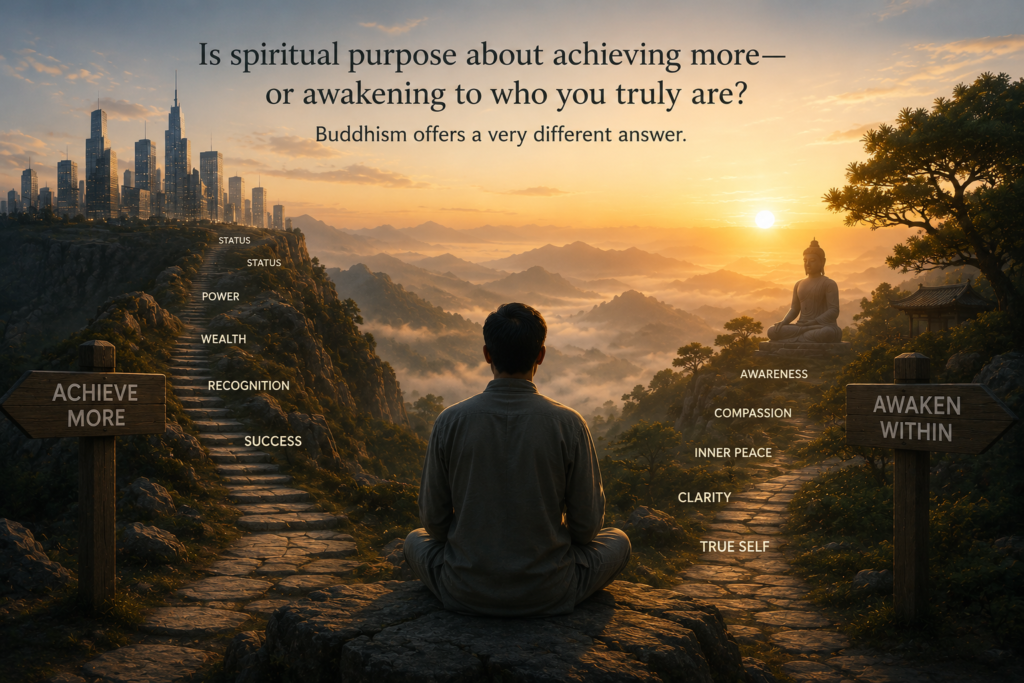
From a Buddhist perspective, the spiritual purpose of life is not to fulfill a unique destiny, gain divine approval, or accumulate worldly success. Instead, it is the gradual awakening of the mind. Buddhism teaches that the deepest purpose of human life is to free ourselves from suffering by understanding reality as it truly is. This transformation is not achieved through external accomplishments but through inner wisdom, compassion, and self-cultivation.
Unlike many modern ideas that encourage people to “find their purpose” by pursuing a career, passion, or personal mission, Buddhism asks a different question: Why do we continue to suffer even when we achieve what we desire? The answer to this question shapes the Buddhist understanding of spiritual purpose.
Spiritual Purpose Begins with Understanding Suffering
Buddhism starts with a simple but profound observation: suffering is an unavoidable part of human life. Physical pain, emotional loss, anxiety about the future, disappointment, aging, and death are experiences shared by everyone. Even moments of happiness are temporary, and the fear of losing them often creates new forms of suffering.
This idea is known as dukkha, a word that refers not only to obvious pain but also to the deeper sense of dissatisfaction that accompanies an impermanent world. According to Buddhism, if we ignore this reality and spend our lives chasing endless pleasure, wealth, or recognition, we may experience temporary satisfaction, but lasting fulfillment will remain out of reach.
For this reason, Buddhism teaches that the search for spiritual purpose begins with honestly recognizing the nature of suffering. Understanding suffering is not pessimism. Instead, it is the first step toward genuine freedom because we cannot solve a problem until we understand its cause.
Ignorance Is the Root of Human Suffering
If suffering is the problem, what causes it?
Buddhism points to ignorance (avidyā). This does not mean a lack of education or intelligence. Rather, it refers to misunderstanding the true nature of reality. We often believe that lasting happiness can be found in temporary things. We become attached to wealth, status, relationships, or even our own identity, expecting them to provide permanent security. Yet everything changes.
When reality inevitably changes, attachment turns into disappointment, fear, anger, or grief. From the Buddhist perspective, these experiences are not caused by the world itself but by our mistaken understanding of it.
Therefore, spiritual purpose is closely connected to developing wisdom. Through mindfulness, meditation, ethical living, and self-reflection, people gradually learn to observe their thoughts and desires without becoming controlled by them. As ignorance begins to fade, reality becomes clearer, and the mind becomes more peaceful. Buddhism regards this growth in wisdom as an essential part of life’s spiritual purpose because it frees us from the illusions that keep suffering alive.
Compassion Is the Natural Expression of Wisdom
As wisdom grows, another transformation naturally follows: compassion.
Buddhism teaches that much of human conflict comes from excessive attachment to the self. We constantly divide the world into “me” and “others,” protecting our own interests while fearing loss and competition. This self-centered perspective creates separation and suffering.
However, as wisdom deepens, we begin to recognize that everyone experiences fear, loss, hope, and suffering. This understanding naturally gives rise to compassion. Helping others is no longer simply a moral obligation or an act of generosity. Instead, it becomes an expression of seeing reality more clearly.
For this reason, Buddhism does not separate personal growth from the well-being of others. A person who becomes wiser also becomes more compassionate. Reducing suffering—both within ourselves and in the lives of others—is therefore an important expression of spiritual purpose.
Awakening Is the Fulfillment of Spiritual Purpose
The highest spiritual purpose in Buddhism is awakening (Bodhi).
Awakening does not mean escaping the world or withdrawing from everyday life. Rather, it means seeing reality without the distortions of greed, hatred, and delusion. An awakened person still lives in the same world, but no longer experiences life through constant attachment and fear.
As wisdom and compassion mature together, the mind gradually moves toward nirvana, a state of profound inner freedom and peace. Nirvana is not simply the absence of suffering. It represents liberation from the mental patterns that create suffering in the first place.
From a Buddhist perspective, awakening is the fulfillment of spiritual purpose because it allows human beings to live in harmony with reality instead of struggling against it. Rather than endlessly searching for happiness outside themselves, they discover a freedom that cannot be shaken by changing circumstances.
A Different Understanding of Spiritual Purpose
Ultimately, Buddhism offers a different answer to the question of spiritual purpose than many modern philosophies.
Instead of asking, “What unique mission was I born to accomplish?” Buddhism asks, “How can I awaken from ignorance and live with wisdom and compassion?”
In this view, the purpose of life is not defined by external achievements but by inner transformation. Spiritual purpose begins with recognizing suffering, deepens through the cultivation of wisdom, expresses itself as compassion, and reaches its fulfillment in awakening. Rather than becoming someone new, Buddhism invites us to see ourselves—and life itself—with greater clarity, freedom, and peace.
Spiritual Purpose Special Topic Spiritual Purpose