People often search for a spiritual purpose because they sense that success, achievement, or material comfort cannot fully explain why they are here. In many Western traditions, spiritual purpose is often understood as something to discover—a calling from God, a unique mission, or a personal path that gives life meaning.
Eastern philosophy approaches the same question from a different direction. Rather than asking, “What special purpose should I find?” it asks, “How should I live in harmony with reality?” Spiritual purpose is not primarily about pursuing an external goal. It is a lifelong process of returning to what is true, cultivating who we are, and ultimately becoming free from what binds us.
Although Confucianism, Taoism, and Buddhism differ in many ways, they share three broad insights into the spiritual purpose of human life.
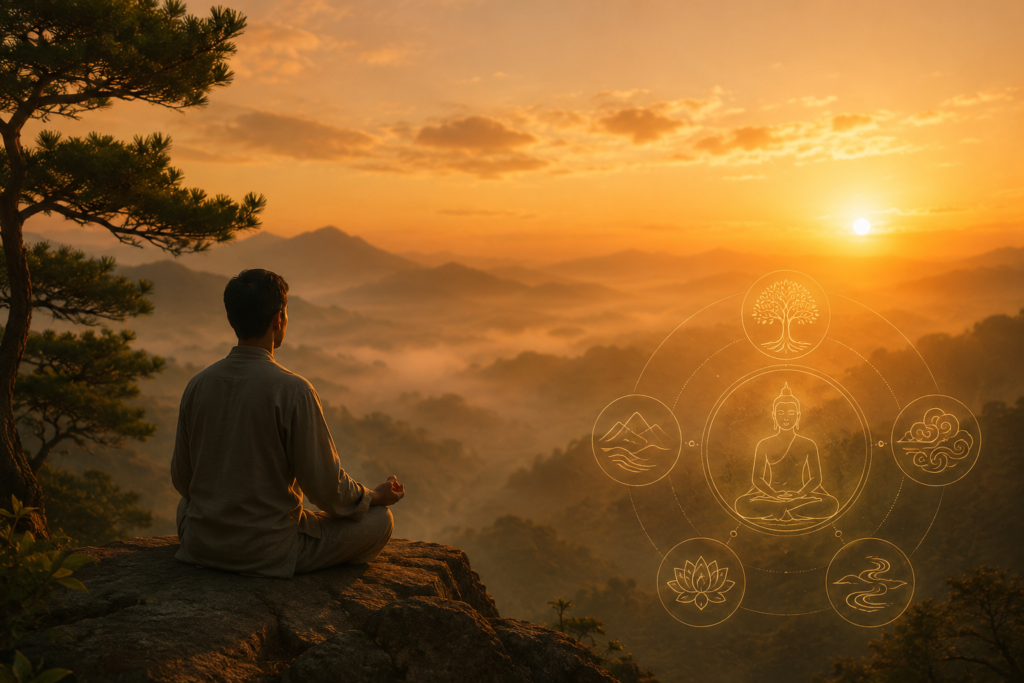
Spiritual Purpose Begins by Living in Harmony with the Greater Order
Eastern philosophy teaches that human beings are not separate from the universe but part of a larger order. Spiritual purpose therefore begins with understanding how life itself works rather than trying to control it.
In Taoism, this is expressed through living in accordance with the Dao (Tao), the natural way of the universe. Confucianism also emphasizes living in accordance with Heaven’s Way, believing that a meaningful life grows from aligning human conduct with a deeper moral order.
From this perspective, suffering often arises when people struggle against reality, pursue endless control, or ignore the natural rhythms of life. Spiritual fulfillment is found not in conquering the world, but in learning to move with it.
Spiritual Purpose Grows Through Inner Cultivation
Living in harmony with reality is only the beginning. Eastern philosophy also teaches that spiritual purpose requires continuous inner cultivation.
Confucianism encourages self-cultivation through virtue, responsibility, and moral discipline. Buddhism teaches that greed, hatred, and ignorance gradually weaken through ethical living, mindfulness, and wisdom. Across these traditions, self-discipline is not seen as punishment but as a way of refining character and bringing out our highest qualities.
From an Eastern perspective, spiritual growth is not about becoming extraordinary. It is about becoming more truthful, compassionate, and wise through the choices we make every day.
Spiritual Purpose Finds Fulfillment in Transcending Attachment
The highest expression of spiritual purpose is not success, status, or recognition, but inner freedom.
Eastern philosophy suggests that much of human suffering comes from attachment—to wealth, achievement, reputation, possessions, and even fixed ideas about ourselves. As long as our happiness depends entirely on these external conditions, lasting peace remains difficult to find.
Buddhism describes this as freedom from attachment. Taoism encourages freedom from artificial desires and excessive striving. Many Eastern traditions therefore see spiritual purpose as the gradual transcendence of the ego rather than the endless pursuit of worldly success.
This does not mean rejecting ordinary life. Rather, it means learning to participate in life without becoming imprisoned by it.
Conclusion
From an Eastern philosophical perspective, spiritual purpose is an inward journey. It begins by living in harmony with the greater order of life, grows through continuous self-cultivation, and reaches its fulfillment by transcending attachment and the limitations of the ego.
Instead of asking us to search for meaning somewhere outside ourselves, Eastern philosophy invites us to transform the way we live. In doing so, spiritual purpose is no longer something we chase—it becomes something we gradually embody.
Spiritual Purpose Special Topic Spiritual Purpose