Core Idea
What if the question “Are we alone in the universe?” is not really about aliens at all?
What if it is part of a much larger set of questions that human beings have been asking for thousands of years?
Questions about consciousness.
Questions about existence.
Questions about meaning.
Questions about ourselves.
Perhaps the search for extraterrestrial life and the search for the meaning of life are not separate journeys. Perhaps they are different paths leading toward the same mystery.
The Question Beyond Aliens
When people ask whether we are alone in the universe, they are usually imagining distant planets, advanced civilizations, or signals arriving from the stars.
But beneath that curiosity lies another question:
What is humanity’s place in the universe?
If intelligent life exists everywhere, what does that mean for us?
If intelligent life exists nowhere else, what does that mean for us?
Why does the answer seem so important?
Why do we care whether humanity is unique?
If We Are Not Alone
Suppose the universe is filled with civilizations.
Suppose there are countless worlds where intelligent beings look up at their own night skies and ask the same questions we ask.
Would that make human life less special?
Or would it reveal that consciousness is a natural expression of the cosmos?
If intelligence emerges repeatedly throughout the universe, is consciousness an accident—or a pattern?
Is life rare?
Or is life one of the things the universe naturally does?
If We Are Alone
Now imagine the opposite.
Imagine that among billions of galaxies and trillions of stars, humanity is the only intelligent civilization.
What would that imply?
Would it make human existence extraordinarily significant?
Would it place a unique responsibility upon us?
Why would a universe so vast produce only a single species capable of wondering about its own existence?
Why does the cosmos contain beings that can ask questions about the cosmos?
The Consciousness Question
These questions eventually lead somewhere unexpected.
Not to astronomy.
But to consciousness.
What exactly is the thing that is asking these questions?
What is awareness?
What is the experience of being?
Can consciousness be fully explained by the brain?
Or does consciousness point toward something deeper that we do not yet understand?
Why does matter become aware of itself?
Why should a collection of atoms ever experience thoughts, emotions, beauty, wonder, or meaning?
The Existence Question
And behind consciousness lies an even larger mystery.
Why does the universe exist at all?
Why is there something rather than nothing?
Why do the laws of nature exist?
Why is the universe ordered in ways that allow stars, planets, life, and minds to emerge?
Could reality have been different?
Or was the appearance of complexity somehow inevitable?
The Meaning Question
Eventually all roads seem to converge on a single question:
What gives life meaning?
Is meaning something built into the universe?
Or is meaning something created by conscious beings?
Why do people continue searching for meaning even after achieving comfort, wealth, success, and security?
Why does the question refuse to disappear?
Is meaning a human invention?
Or is it a clue pointing toward a deeper structure of reality?
One Mystery, Many Questions
Perhaps these are not separate questions at all.
- Are we alone in the universe?
- What is consciousness?
- Why does the universe exist?
- What is the meaning of life?
Maybe they are different expressions of the same fundamental inquiry.
Human beings search the stars for other civilizations.
They study the brain to understand consciousness.
They explore physics to understand reality.
They turn to philosophy to understand meaning.
But in every case, they are asking some version of the same question:
What are we, and why are we here?
And perhaps the most important possibility is not that we eventually discover the answer.
Perhaps it is that these questions themselves reveal something profound about what it means to be human.
For in a universe that can produce stars, galaxies, planets, and life, one of the strangest things of all may be this:
It has produced beings capable of wondering why any of it exists in the first place.
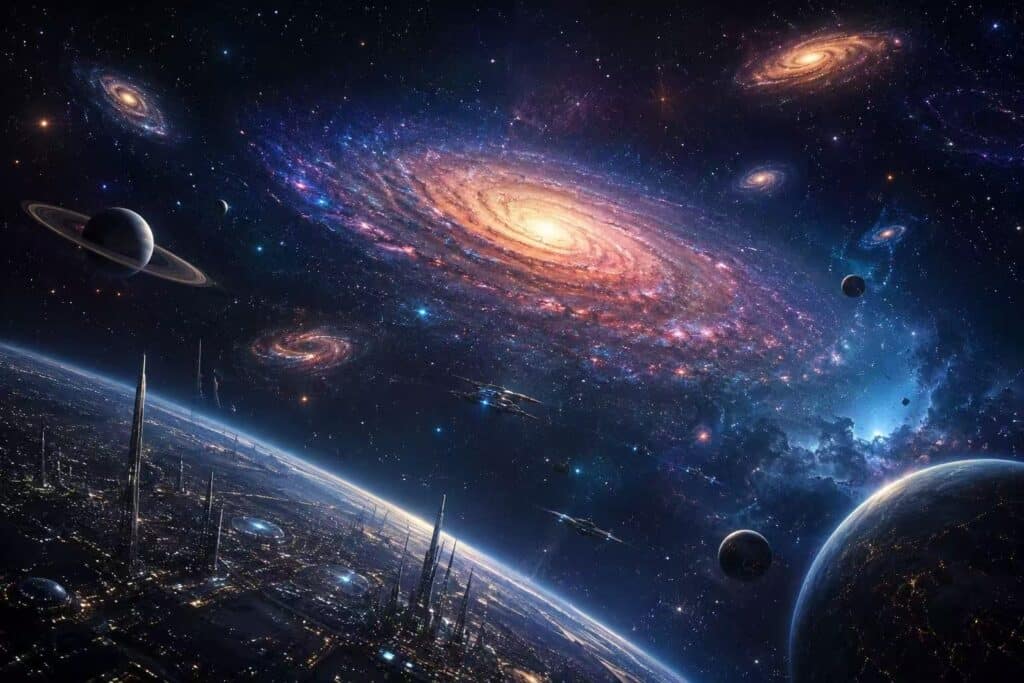
My Eastern Perspective: A Different Way of Seeing This Question
From an Eastern philosophical perspective, this question is not fundamentally about whether extraterrestrial life exists. It is, at its core, a question about humanity’s position within the structure of the universe.
The reason we find this question so compelling is because it touches three essential layers:
First, whether we are truly alone—whether human life is the only form of consciousness in existence.
Second, whether life and consciousness are universal phenomena, or extremely rare accidents within cosmic evolution.
Third, whether humanity possesses any inherent “special status,” or whether we are simply a natural outcome of universal processes.
The importance of this question lies in the fact that it reshapes how we understand ourselves, how we interpret the meaning of life, and how we imagine the direction of future civilization.
From this viewpoint, my conclusion is simple:
Life is not a rare accident or an isolated occurrence, but a natural outcome of the evolutionary laws of the universe.
Next Article
The Universe Doesn’t Confuse Us. We Do. Why the Meaning of Life Question Never Goes Away
What Is the Meaning of Life? An Eastern Philosophy Guide to Humanity’s Greatest Question Meaning of Life