Core Idea
You don’t really start with questions about the universe.
You start with something quieter.
Something personal.
Something uncomfortable.
And eventually, it leads you to the same place every time:
Why am I here at all?
It Always Starts the Same Way
It rarely begins with philosophy.
It begins with moments like these:
- Lying awake at night, thinking about everything and nothing
- Achieving something you wanted… and feeling almost nothing afterward
- Looking at the night sky and suddenly feeling small in a way you can’t explain
- Realizing that success doesn’t automatically produce meaning
And then, without warning, the mind drifts outward.
To space.
To time.
To existence itself.
And the questions begin.
The Questions We Ask About the Universe
What happened before the Big Bang?
Why is there something instead of nothing?
Did time have a beginning?
Is our universe the only one?
Are we alone in the universe?
And if we are not—what does that mean for us?
At first, these feel like scientific questions.
Cosmology. Physics. Mathematics.
But something strange happens the deeper you go.
They stop feeling like questions about the universe.
And start feeling like questions about us.
Then the Questions Turn Back on Us
Even if we explained everything about the cosmos, something would still remain unresolved.
Why did life appear at all?
Why does consciousness exist?
Why does the universe contain beings that can question the universe itself?
What is consciousness?
Is the brain producing everything we experience—or is that assumption too limited?
Do we actually have free will?
Or are we just watching decisions unfold?
Why do humans search for meaning in the first place?
Why is survival not enough anymore?
Why do we ask questions that don’t help us survive at all?
At this point, something shifts.
The universe is no longer the main mystery.
We are.
The Questions That Become Impossible to Ignore
Then it becomes even more personal.
Why does modern life feel empty, even when everything is “fine”?
Why doesn’t success guarantee fulfillment?
Why do achievement and emptiness often show up together?
Why do we immediately replace one goal with another?
What are we actually chasing?
Happiness?
Or something deeper?
Is meaning something we discover?
Or something we construct?
And if the universe has no built-in purpose…
Does that mean life has none either?
Or does it mean we misunderstood what meaning is in the first place?
These are no longer scientific questions.
They are existential ones.
And at some point, almost everyone runs into them.
The Strange Pattern Behind All Human Questions
If you zoom out far enough, something becomes visible.
We are constantly asking different versions of the same questions:
- Are we alone in the universe?
- Where did everything come from?
- What is consciousness?
- Do we have free will?
- Why do we feel empty?
- What makes life meaningful?
Different topics.
Same direction.
Because underneath them all is a single question that never goes away:
Why do we exist at all?
And underneath that question is an even quieter one:
What are we supposed to do with that existence?
The Uncomfortable Truth
Even if we solved everything:
- The origin of the universe
- The nature of consciousness
- The structure of reality
- The existence of other civilizations
One question would still remain.
Not because science failed.
But because something about being human refuses to disappear:
What is the meaning of life?
Maybe this is not a problem to be solved.
Maybe it is a pattern built into awareness itself.
Every question about the universe eventually becomes a question about the mind asking the question.
And every question about the mind eventually becomes a question about meaning.
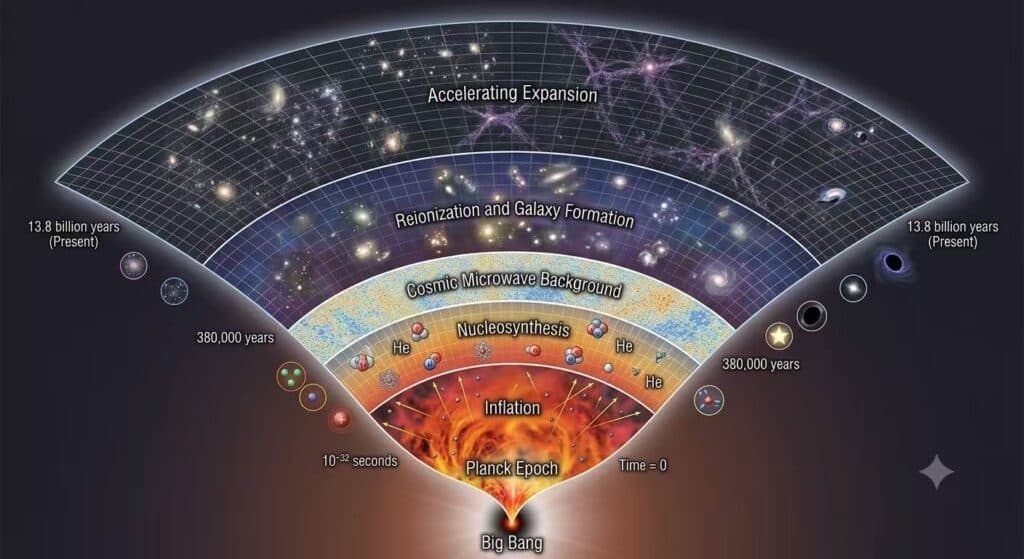
A Different Perspective on the Beginning of Everything
From another Eastern philosophical perspective, the origin of the universe may not have been a simple “start from nothing.”
Instead, it may have unfolded in three stages:
- Before the Big Bang: latent buildup, not emptiness
Rather than absolute nothingness, the early state may have been a slow, structured accumulation of energy at microscopic levels—an invisible tension building toward instability.
- The moment of origin: a phase transition of reality
The Big Bang may not have been an explosion in space.
But a transformation of space itself.
A sudden breakdown of equilibrium, releasing unimaginable energy and triggering the expansion of space-time.
- What remains today: echoes of the beginning
We cannot observe the origin directly.
But we can read its traces:
- The cosmic microwave background—the fading afterglow of the early universe
- Dark energy—an invisible force still shaping cosmic expansion
In this sense, the universe is not something we observe from the outside.
It is something we are still inside of.
Still decoding.
Still becoming.
Final Thought
We usually think the biggest questions are about the universe.
But eventually, every cosmic question becomes personal.
And every personal question becomes existential.
The journey begins with space.
But it always returns to the same place:
the mind asking why anything exists at all.
Next Article
Are We Living in a Simulation? Why the Question May Be About Meaning More Than Reality
What Is the Meaning of Life? An Eastern Philosophy Guide to Humanity’s Greatest Question Meaning of Life