Core Idea
The simulation hypothesis is usually presented as a question about technology.
Could an advanced civilization create a world so realistic that its inhabitants would never know they were living inside it?
It is a fascinating idea, but the longer I think about it, the less interested I become in the technology itself.
The question that keeps pulling me back is a different one:
If reality is a simulation, what does that mean for the way we live?
And perhaps more importantly:
What does it mean for the search for meaning?
A Question Bigger Than Technology
The simulation hypothesis challenges one of our deepest assumptions: that the reality we experience is the ultimate reality.
If the hypothesis were true, the universe would not be the final layer of existence. It would be one layer within something larger.
For many people, that possibility feels unsettling.
If everything around us is generated by a system, does anything really matter?
Does love matter?
Does suffering matter?
Do our choices matter?
At first glance, the simulation hypothesis seems to threaten meaning.
But I am not convinced that it does.
The Strange Thing About Experience
Imagine discovering tomorrow that reality is simulated.
What would actually change?
The sunrise would still look beautiful.
A parent’s love for a child would still feel real.
Friendship would still matter.
Loss would still hurt.
Joy would still feel like joy.
The structure behind reality might be different from what we imagined, but our lived experience would remain.
That observation raises an interesting possibility.
Perhaps meaning does not depend entirely on what reality is.
Perhaps it depends on how reality is experienced.
The simulation hypothesis may change our understanding of the stage, but it does not automatically erase the significance of the play.
Why Build a World Like This?
Why would such a world exist in the first place?
Why create a reality filled with uncertainty, limitation, struggle, and contradiction?
Why not design a world without confusion, failure, loss, or pain?
These questions interest me far more than the technical details of the simulation itself.
A world without obstacles might be comfortable.
It might also be a world in which nothing grows.
Many of the qualities we admire most—wisdom, resilience, compassion, creativity, courage—seem to emerge from challenge rather than comfort.
Perhaps limitation is not merely a flaw in the system.
Perhaps it serves a purpose.
An Eastern Way of Looking at the Question
From an Eastern perspective, I find myself approaching the simulation hypothesis differently.
I do not see human beings as trapped characters inside a meaningless program.
Nor do I see reality as something that must be escaped.
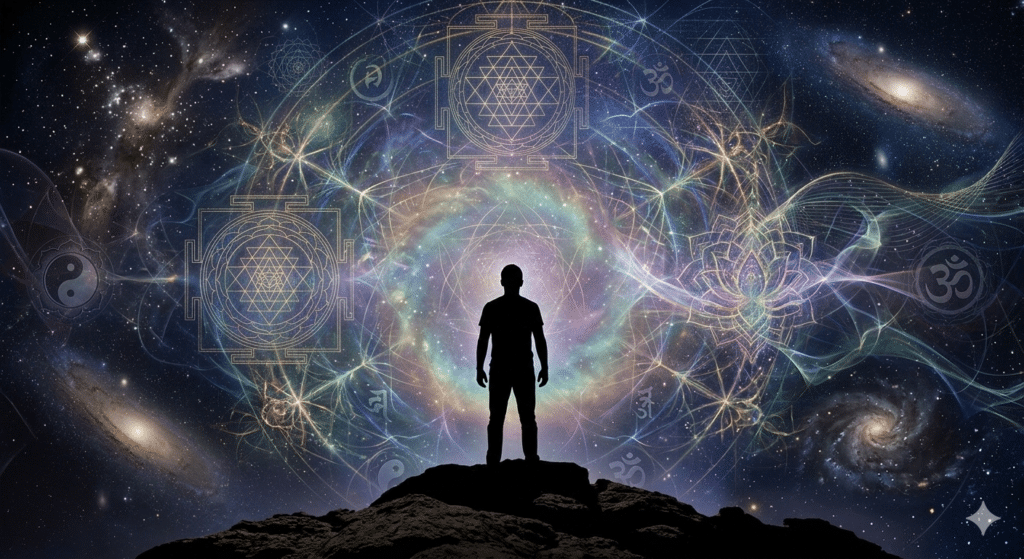
Instead, one possible interpretation is that reality functions like a vast experiential environment—a place where consciousness encounters limits, relationships, choices, and consequences.
Whether that environment is ultimately physical, spiritual, simulated, or something beyond all of those categories may be less important than how we participate in it.
Many Eastern traditions place less emphasis on controlling the external world and more emphasis on understanding oneself within it.
The question is not simply:
“What kind of world is this?”
The question is also:
“What is this world trying to teach me?”
Meaning Through Participation
This perspective does not claim to have the final answer.
It is simply a way of looking at the problem.
Life may be less like a prison and more like a classroom.
Less like a trap and more like a training ground.
Experience itself becomes meaningful.
Creativity becomes meaningful.
Relationships become meaningful.
Growth becomes meaningful.
The purpose of life is not necessarily found at the end of the journey. It may emerge through the journey itself.
In that sense, meaning is not something waiting to be discovered outside the simulation.
It is something that develops through participation within it.
The Search for the Hidden Source
One aspect of human nature has remained remarkably consistent across cultures and throughout history.
People keep looking beyond appearances.
They search for patterns.
They search for order.
They search for a deeper source behind existence itself.
Some call it God.
Some call it the Dao.
Some call it ultimate reality.
Others leave it unnamed.
The names matter less than the impulse.
The desire to understand where we come from—and what we are part of—appears deeply woven into the human experience.
Perhaps this search is not separate from the meaning of life.
Perhaps it is part of the meaning of life.
A Different Way to Ask the Question
The simulation hypothesis asks:
“Is this world real?”
An Eastern perspective might respond with a different question:
“What am I meant to learn from being here?”
One question focuses on the nature of reality.
The other focuses on the purpose of experience.
Both are valuable.
But if I had to choose between knowing with certainty that reality is a simulation and understanding how to live meaningfully within it, I would choose the second.
Because whether reality is simulated or not, life is still being lived.
Choices are still being made.
Experiences are still being felt.
And meaning is still being sought.
Perhaps the most important question is not whether we are living inside a simulation.
Perhaps the more important question is what consciousness is capable of becoming while it is here.
Next Article
What Is the Meaning of Life? An Eastern Philosophy Guide to Humanity’s Greatest Question Meaning of Life