This article reflects my personal understanding after many years of studying Buddhism while presenting its ideas in a way that is accessible to modern Western readers. Some interpretations may differ from traditional Buddhist teachings or academic psychology, and that is perfectly fine. My hope is simply to offer another perspective for reflection.
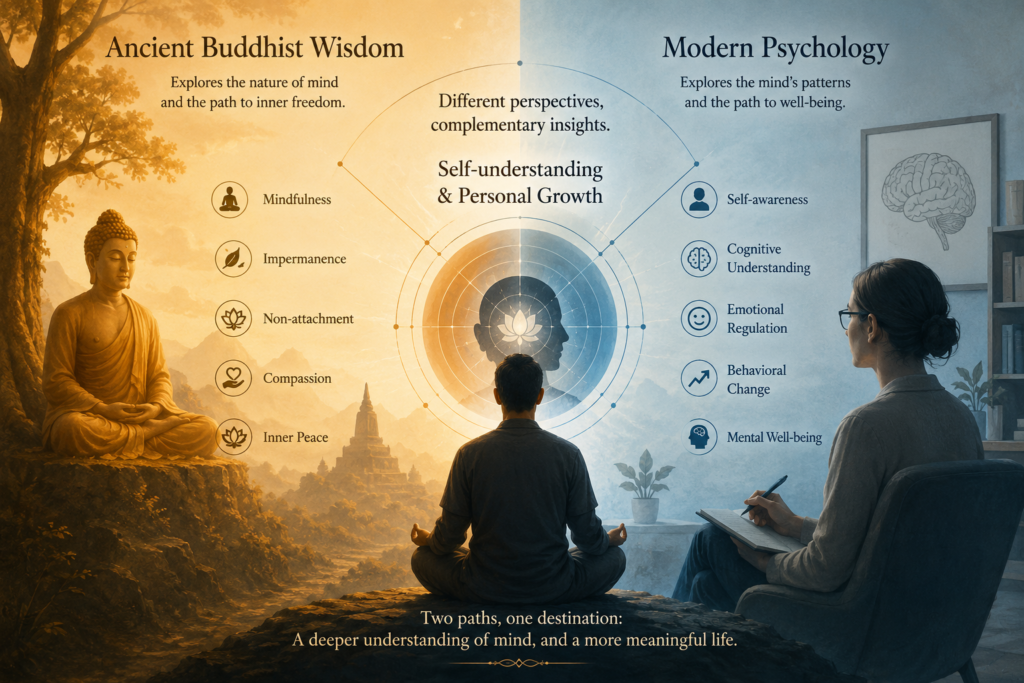
The Relationship Between Buddhism and Modern Psychology
At first glance, Buddhism and modern psychology seem to belong to completely different worlds.
One is an ancient spiritual tradition that has explored the nature of the mind for over two thousand years. The other is a modern discipline that studies human thought and behavior through observation and research.
Yet despite their different origins, they often ask remarkably similar questions:
- Why do people suffer?
- Why do we become attached to certain thoughts and emotions?
- Is lasting inner peace possible?
- Can we understand ourselves more deeply?
Although they offer different answers and use different methods, Buddhism and modern psychology often meet in their shared curiosity about the human mind.
Looking Within: The Practice of Self-Observation
Both Buddhism and modern psychology encourage a simple but powerful shift:
Instead of constantly trying to change the outside world, begin by observing the inner world.
In Buddhism, this practice is known as Vipassanā (Insight Meditation), a form of mindful observation that allows practitioners to see thoughts, emotions, and experiences without immediately reacting to them.
Rather than asking us to suppress thoughts or chase pleasant experiences, Vipassanā invites us to notice how the mind naturally works.
Many modern approaches to understanding the mind also emphasize self-awareness, reflection, and recognizing habitual patterns of thinking. Although their methods may differ, both traditions suggest that greater clarity begins with honest observation.
In this sense, awareness is not something we acquire from the outside—it is something we gradually uncover.
Buddha-Nature and Human Potential
One of Buddhism’s most distinctive teachings is Buddha-nature (Tathāgatagarbha).
In Mahāyāna Buddhism, Buddha-nature refers to the inherent capacity for wisdom, compassion, and awakening that exists within every person.
This does not mean that everyone is already enlightened. Rather, it suggests that beneath confusion, attachment, and ignorance lies the possibility of profound clarity.
Modern psychology often speaks about human potential using different language. It may describe personal growth, self-understanding, or the development of inner strengths.
The vocabulary is different, but both perspectives share an optimistic view of human nature: people are capable of becoming wiser through deeper understanding of themselves.
Compassion as a Way of Living
Buddhism is not only about understanding the mind—it is also about transforming how we relate to others.
The practice of Karuṇā (compassion) encourages us to recognize that every person experiences struggles, hopes, and fears. From this understanding naturally arises kindness, patience, and empathy.
Modern psychology also recognizes the importance of healthy relationships, empathy, and emotional connection in human life.
Although the explanations may differ, both traditions suggest that genuine compassion is not a sign of weakness. It is a form of wisdom that benefits both ourselves and those around us.
Learning from Difficult Experiences
Life inevitably includes disappointment, uncertainty, and change.
Buddhism does not view these experiences as meaningless obstacles. Instead, it teaches that they can become opportunities for developing Prajñā (wisdom).
A famous Buddhist expression says:
“Afflictions can become Bodhi.”
This does not mean that suffering is desirable. Rather, it means that moments of difficulty often reveal our attachments, assumptions, and habitual ways of seeing the world. By understanding these patterns, we may gradually develop greater freedom and insight.
Modern psychology similarly encourages people to reflect on life experiences and discover new perspectives rather than remaining trapped by old patterns.
Both traditions suggest that personal growth often begins with honest observation rather than avoidance.
Different Paths Toward Understanding the Mind
Despite their similarities, Buddhism and modern psychology are not the same.
Modern psychology generally studies observable human experience through research, evidence, and scientific methods. Its primary goal is to understand how the mind functions and how people can live more effectively in everyday life.
Buddhism begins with direct personal experience through meditation and contemplative practice. While it also explores the mind, its ultimate aim extends beyond everyday well-being toward awakening (Bodhi)—a profound realization of reality that includes the teachings of impermanence (Anicca), non-self (Anattā), and emptiness (Śūnyatā).
Rather than competing with one another, these two traditions can be viewed as offering different perspectives on the same human experience.
One primarily asks, “How does the mind work?”
The other asks, “What is the deepest nature of the mind?”
These questions are not identical, but they can enrich one another.
Two Traditions, One Shared Curiosity
Buddhism and modern psychology arose in different cultures and different eras, yet both are rooted in humanity’s timeless desire to understand the mind.
Psychology contributes careful observation and scientific inquiry.
Buddhism contributes centuries of contemplative practice and philosophical insight.
Neither completely replaces the other.
Instead, they invite us to explore ourselves from different angles.
Perhaps their greatest meeting point is not found in any single theory, but in a shared invitation:
Look inward with curiosity, observe with mindfulness, and allow wisdom to grow through direct experience.
Buddhism Special Topic Buddhism