This article reflects my understanding after many years of studying Buddhism and presenting its ideas in a way that is easier for Western readers to understand. Different Buddhist traditions may explain certain concepts differently, and that’s perfectly okay. My hope is simply to offer a perspective that inspires you to explore your own understanding.
Death has always been one of humanity’s greatest mysteries. Nearly every culture asks the same questions:
- What happens after we die?
- Is death the end?
- Why are we so afraid of it?
Buddhism offers an answer that is both profound and surprisingly practical. Rather than seeing death as either complete annihilation or eternal salvation, Buddhism understands death as a natural transition within the continuous flow of existence.
Let’s explore this perspective through several core Buddhist teachings.
1.Death Is Not the End, but a Continuation of Consciousness
Many people assume that death is simply the moment when everything ceases to exist. In Buddhist philosophy, this view is often called nihilism or the view of annihilation—the belief that life ends completely when the body dies.
Many Buddhist traditions offer a different perspective.
They teach that what continues after death is not an eternal soul, but a continuity or stream of consciousness that carries the influence of our past actions, intentions, habits, and karma.
Karma literally means “action.” In Buddhism, it refers to the moral cause-and-effect created by our thoughts, words, and deeds. Every intentional action leaves an imprint that influences future experience.
From this perspective, death is less like a light being switched off and more like a traveler leaving an old house that has become uninhabitable. The body eventually wears out, but the stream of consciousness continues its journey, shaped by karma and conditions.
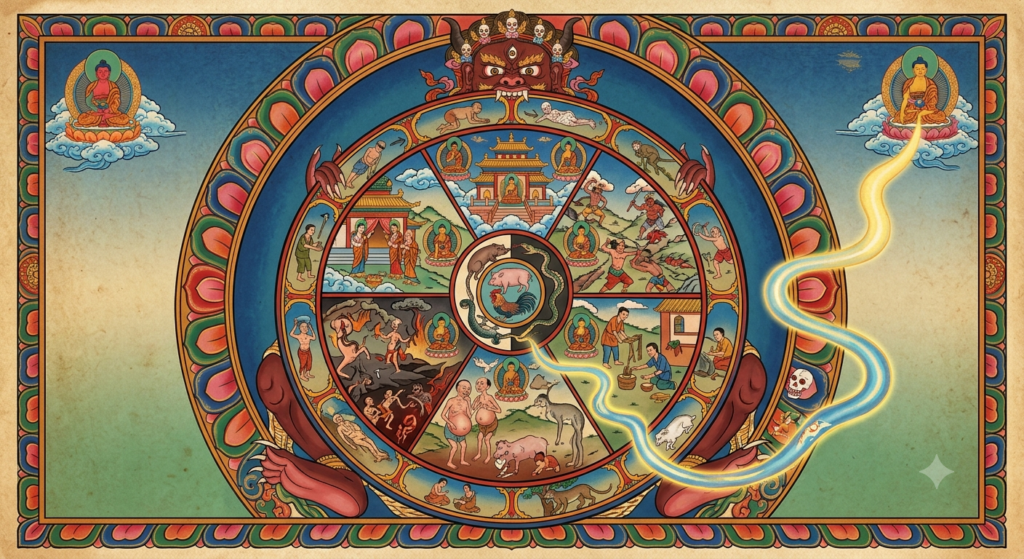
This ongoing process is known as rebirth, which many Buddhist traditions describe as taking place within the Six Realms of Existence. Whether understood literally or symbolically, the essential teaching remains the same: death is not viewed as an absolute ending, but as a transition.
2.The Body Ends, but Causes and Conditions Continue
One of Buddhism’s central teachings is impermanence (Anicca).
Everything that arises will eventually change.
Mountains erode.
Stars burn out.
Our bodies grow, age, and eventually die.
This is not considered a tragedy—it is simply the nature of conditioned existence.
A traditional Buddhist metaphor compares life to one candle lighting another.
The first flame disappears, yet the fire continues.
Likewise, the physical body eventually comes to an end, but the momentum created by karma gives rise to new conditions, allowing the continuity of existence to unfold.
In this sense, death is neither absolute destruction nor permanent preservation.
It is transformation.
3.Death Reveals the Truth of Impermanence and Non-Self
Many Buddhist traditions describe the dying process as the gradual dissolution of the Four Great Elements (Mahābhūta):
- Earth — solidity, such as bones and muscles.
- Water — bodily fluids.
- Fire — warmth and metabolism.
- Wind — breath and movement.
Traditional Buddhist teachings explain that these elements gradually separate as life comes to an end.
Whether understood literally, symbolically, or as part of contemplative practice, the deeper point is that the body we identify as “me” is actually a temporary combination of changing conditions.
This insight points toward another central Buddhist teaching: Anattā (Non-Self).
Buddhism does not deny our experience of having a personal identity.
Instead, it suggests that there is no permanent, independent, unchanging self hiding behind our experiences.
What we call “I” is a constantly changing process rather than a fixed entity.
Recognizing this can fundamentally change how we relate to death.
4.Emptiness Does Not Mean Nothing Exists
Perhaps no Buddhist concept is more misunderstood than Śūnyatā (Emptiness).
In everyday English, “empty” often sounds like “nothing exists.”
That is not what Buddhism means.
Emptiness means that nothing exists independently or permanently.
Everything exists because of countless causes and conditions.
A flower depends on sunlight, water, soil, time, and countless other factors.
Without these conditions, the flower cannot exist.
The same is true for ourselves.
Our bodies, personalities, relationships, achievements, and even our fears are all interconnected processes rather than isolated objects.
Understanding emptiness does not make life meaningless.
Instead, it helps loosen our attachment to the illusion that anything can remain exactly the same forever.
Death becomes less frightening when we realize that change has always been the nature of life.
5.The Real Question Is Not How We Die, but How We Live
From a Buddhist perspective, reflecting on death is not meant to create fear.
It is meant to awaken wisdom.
If everything is impermanent…
If every action creates karma…
If life is constantly changing…
Then every moment becomes precious.
Death reminds us to live with greater compassion, greater mindfulness, and greater awareness.
Rather than asking,
“How can I avoid death?”
Buddhism encourages us to ask,
“How can I live so that when death comes, there is nothing left to regret?”
In this way, death is not simply the end of life.
It becomes one of life’s greatest teachers.
Final Thoughts
Buddhism does not ask us to fear death, nor does it ask us to deny it.
Instead, it invites us to understand death as part of the natural rhythm of existence—a continuation shaped by karma, illuminated by impermanence (Anicca), freed through the realization of non-self (Anattā), and ultimately understood through the wisdom of emptiness (Śūnyatā).
When death is seen in this light, it is no longer merely an ending.
It becomes an invitation to live more wisely, more compassionately, and more fully in the present moment.
Buddhism Special Topic Buddhism