This article reflects my own understanding after many years of studying Buddhism and presenting its ideas in a way that is easier for Western readers to understand. You may not agree with every interpretation—and that’s perfectly fine. My hope is simply to offer a different perspective that helps you discover your own answers.
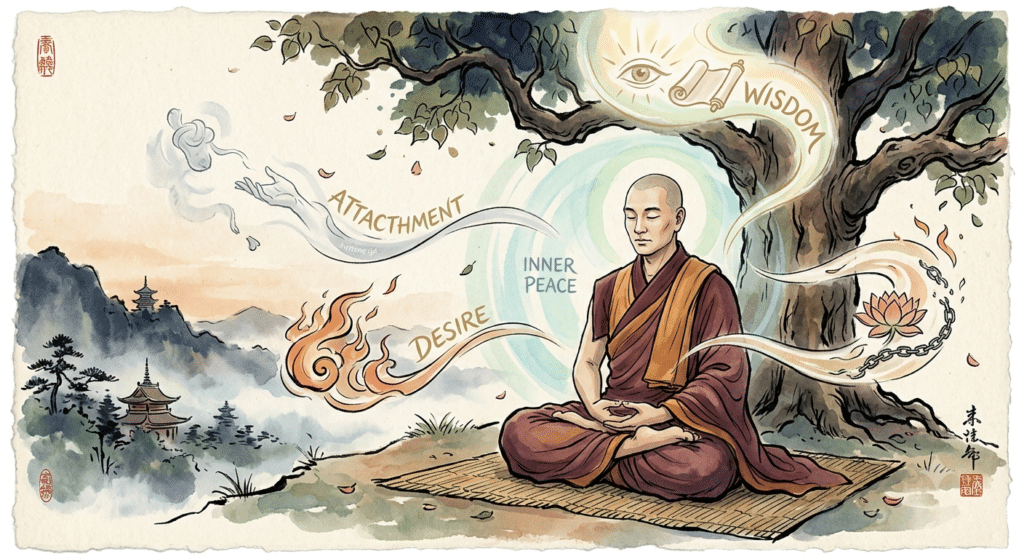
We Are Not Controlled by the World—We Are Controlled by Desire
Imagine finally buying something you’ve wanted for months.
For a moment, you feel excited. Maybe even fulfilled.
But a few days later, something changes.
Your attention quietly shifts toward the next thing you want.
A newer phone.
A bigger house.
More recognition.
A better relationship.
Without realizing it, your happiness has moved somewhere else again.
According to Buddhism, this is not a personal weakness. It is a universal pattern of the human mind.
Buddhism teaches that much of human life is quietly woven together by desire. It influences our choices, emotions, relationships, and even our sense of identity. Understanding desire is therefore not a minor topic—it is one of the central keys to understanding both suffering and freedom.
1.The Nature of Desire: Ignorance (Avidyā) Creates Craving (Taṇhā)
Many people assume that desire itself is freedom.
Buddhism suggests something almost opposite.
It teaches that blind desire is born from Ignorance (Avidyā).
Here, “ignorance” does not mean a lack of education or intelligence. It means misunderstanding the nature of reality.
Because we fail to see reality clearly, we naturally believe:
“If I can get what I want, then I will finally be happy.”
This misunderstanding gives rise to Craving (Taṇhā)—a restless urge to obtain, keep, or avoid certain experiences.
The Buddha described this craving as one of the deepest causes of human suffering.
It is like drinking salt water when thirsty.
The more you drink, the thirstier you become.
2.Why Desire Never Truly Satisfies
Buddhism is often misunderstood as teaching that all desires are evil.
That is not quite accurate.
The deeper problem is not desire itself, but attachment (Upādāna)—the belief that our lasting happiness depends upon obtaining or keeping something that is constantly changing.
Every attachment quietly contains a hidden condition:
“I will be happy when…”
When happiness depends entirely on external conditions, anxiety naturally follows.
Because everything changes.
Money changes.
Relationships change.
Health changes.
Status changes.
Even our own bodies change.
The Buddha summarized this insight through the teaching of Impermanence (Anicca). Since everything is temporary, trying to build permanent happiness upon temporary things inevitably leads to disappointment.
3.The Five Desires: Why We Keep Chasing
In Buddhist teachings, ordinary people are often driven by what are called the Five Desires—wealth, sensual pleasure, fame, food, and comfort.
These are not condemned simply because they exist.
Rather, Buddhism asks us to examine how we relate to them.
Do we enjoy them?
Or do we depend on them?
The problem begins when appreciation turns into possession.
Instead of experiencing life, we begin trying to own it.
Instead of enjoying success, we fear losing it.
Instead of loving others, we become afraid they might leave us.
This attachment quietly transforms pleasure into insecurity.
An ancient Buddhist metaphor compares worldly desire to licking honey from the edge of a sharp knife.
The sweetness is real.
But so is the wound that follows.
4.The Buddhist Path: Not Suppressing Desire, but Understanding It
One of the biggest misunderstandings about Buddhism is that it asks people to suppress all desire.
In reality, Buddhism points toward something much more subtle.
It encourages us to understand desire so deeply that unhealthy attachment naturally loses its grip.
This begins with Mindfulness (Sati).
Instead of immediately reacting whenever a desire appears, we learn to observe it.
Where did it come from?
How does it feel?
Does it remain the same?
What happens if we simply watch it instead of obeying it?
As awareness grows, desire begins to lose its power over us.
At the same time, Buddhist ethical practice (Śīla, often translated as moral discipline) helps create the inner stability needed for this observation.
Rather than fighting the mind, we gradually train it.
Over time, this cultivation gives rise to Prajñā—wisdom that sees reality more clearly.
5.Freedom Is Not Having Everything—It Is Needing Less
Many people imagine that giving up attachment would make life empty or joyless.
Buddhism offers a very different picture.
When the mind is no longer constantly chasing or resisting experience, it becomes remarkably open.
Peace no longer depends on circumstances.
Contentment no longer depends on possession.
Instead of asking,
“What else do I need?”
the mind quietly begins asking,
“What has always been here beneath all my wanting?”
Buddhism calls this the uncovering of our innate wisdom and clarity.
Some Mahāyāna traditions describe this as allowing one’s Buddha-nature (Tathāgatagarbha) to shine forth—not as something newly created, but as something that was never truly lost.
A Final Reflection
The goal of Buddhism is not to eliminate every human desire.
It is to free us from becoming enslaved by them.
You can still love.
You can still build a career.
You can still pursue meaningful goals.
The difference is that your happiness no longer depends entirely on whether life unfolds exactly as you planned.
When desire is guided by wisdom rather than attachment, life becomes lighter.
When wisdom replaces ignorance, the endless cycle of craving begins to loosen.
Perhaps true freedom is not found in getting everything we want.
Perhaps it begins the moment we no longer need the world to complete us.
Buddhism Special Topic Buddhism