Main Idea
From an Eastern philosophical perspective, AI cannot replace human meaning because meaning does not arise from intelligence, efficiency, or productivity. Meaning emerges from limitation, uncertainty, relationships, suffering, and the awareness that life is finite.
As AI increasingly takes over tasks with clear answers, humanity may be freed from many practical burdens. Yet this does not eliminate meaning. Instead, it may push us toward the deeper questions that have no final answers.
The future is not a competition between humans and AI. It is a new stage in which AI handles certainty while human beings continue exploring meaning.
An Eastern Perspective on AI and Meaning
Much of the modern discussion about artificial intelligence focuses on power.
Will AI become smarter than humans?
Will AI replace jobs?
Will AI surpass human creativity?
These are important questions.
Yet from an Eastern philosophical perspective, they may not be the deepest ones.
For thousands of years, Eastern thought has often focused less on power and more on balance, limitation, and the nature of existence itself.
From this viewpoint, the question is not whether AI can outperform humans.
The question is whether intelligence alone can create meaning.
AI Brings the Liberation of Tools, Not the Replacement of the Human Spirit
Artificial intelligence is one of the most powerful tools humanity has ever created.
It can search vast amounts of knowledge, perform complex calculations, write code, and solve problems with extraordinary efficiency.
In many areas, it may eventually outperform human beings.
Yet what AI replaces are tools.
What it challenges is our traditional pride in skill, productivity, and efficiency.
It does not touch the deeper foundations of human existence.
As technology removes more repetitive and mechanical forms of labor, it may free humanity from countless practical burdens.
This is not the loss of meaning.
It may be the beginning of a different search for meaning.
When survival becomes easier, people inevitably begin asking deeper questions.
Who am I?
What is worth pursuing?
What makes a life meaningful?
These are not questions that can be solved by faster computation.
Meaning Emerges From Limitation
One of the recurring themes in Eastern philosophy is that existence is shaped by boundaries.
A river exists because of its banks.
Music exists because of silence.
A journey exists because there is a destination.
Human meaning follows a similar pattern.
Time is precious because it is limited.
Love is precious because loss is possible.
Life is precious because it eventually ends.
Meaning does not emerge despite limitation.
Meaning emerges because of limitation.
This is where AI encounters a boundary of its own.
AI does not fear death.
AI does not experience pain.
AI does not struggle with uncertainty.
It can describe these experiences.
It cannot live them.
A machine may simulate conversations about meaning.
But simulation is not the same as participation.
Why Humanity Feels Anxious
The rise of AI has created a growing sense of uncertainty.
Many people fear becoming replaceable.
Others worry about losing their value in a world increasingly shaped by algorithms.
Yet beneath these fears lies a deeper concern.
For generations, people have linked meaning to usefulness.
Work became identity.
Productivity became worth.
Achievement became purpose.
When AI begins performing many of these functions, humanity is forced to reconsider an old assumption.
Perhaps usefulness and meaning are not the same thing.
This realization is uncomfortable.
But it may also be necessary.
Periods of uncertainty often become periods of awakening.
AI Is a Mirror, Not a Source of Meaning
AI learns from humanity.
Its knowledge originates from human language, human history, human creativity, and human experience.
In this sense, AI resembles a mirror.
It can reflect the brilliance of human civilization.
It can amplify human capabilities.
It can reveal patterns hidden within vast amounts of information.
But a mirror reflects light.
It does not create it.
AI may help humanity understand the world more clearly.
Yet it cannot determine why the world matters.
That question remains human.
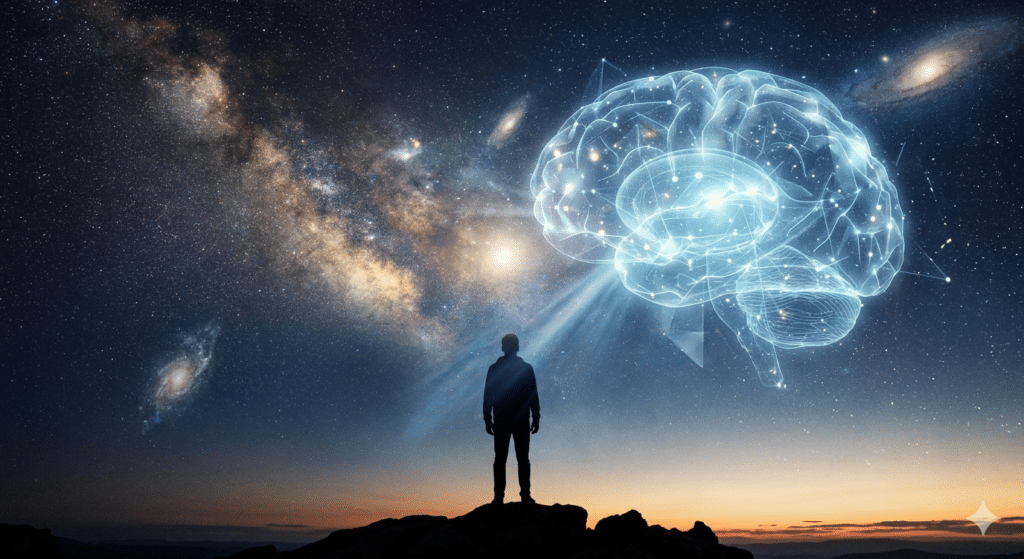
The Future Is the Reconstruction of Meaning
The future is unlikely to be a story of replacement.
It is more likely to be a story of transformation.
AI will increasingly handle questions that have clear answers.
Questions of calculation.
Questions of optimization.
Questions of efficiency.
But the questions that matter most may remain unanswered.
What is love?
What is a good life?
What is worth sacrificing for?
Why are we here?
These questions are not problems waiting for solutions.
They are mysteries that human beings continually explore.
Perhaps the greatest impact of AI will not be that it replaces humanity.
Perhaps it will remind humanity that meaning was never found in intelligence alone.
Meaning is found in the experience of being alive.
And that experience remains uniquely human.
Next Article
If AI Gains a Soul, What Happens to the Future of Humanity?
What Is the Meaning of Life? An Eastern Philosophy Guide to Humanity’s Greatest Question Meaning of Life