One of the biggest surprises for many people is that Buddhism has no creator God.
Yet millions of Buddhists bow before Buddha statues, chant sutras, burn incense, and pray in temples. To someone raised in Christianity, Judaism, or Islam, this can seem confusing.
So does Buddhism believe in God?
The answer depends on what you mean by “God.”
If you mean an all-powerful Creator who made the universe and governs everything, then the answer is no. Buddhism does not teach the existence of such a being.
However, if you mean heavenly beings or supernatural beings, then the answer is yes—Buddhism recognizes many kinds of celestial beings. But unlike the God of many theistic religions, these beings are not creators, are not all-powerful, and are not the ultimate source of salvation.
This distinction reveals one of the most unique features of Buddhism. Rather than centering its teachings on a divine creator, Buddhism centers them on the Dharma—the universal truth that governs reality—and on the possibility that every person can awaken to that truth.
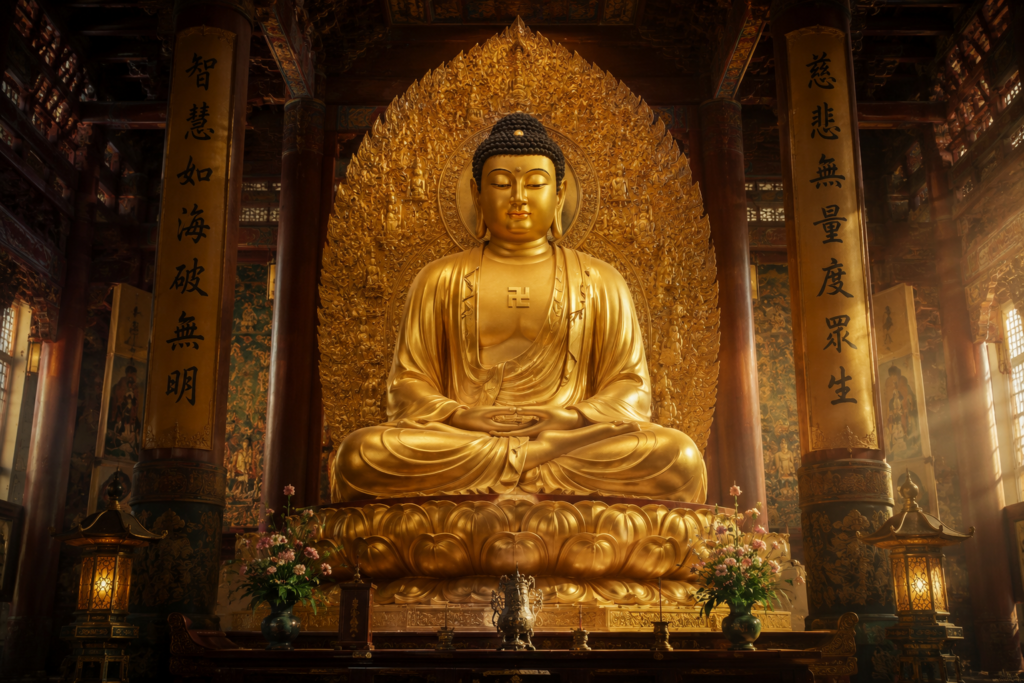
The World Was Not Created by God, but Arises Through Causes and Conditions
Many religions answer humanity’s oldest question with a simple explanation:
The universe exists because God created it.
Buddhism approaches the question differently.
Instead of asking, “Who created the world?” Buddhism asks:
“Under what conditions does anything come into existence?”
The Buddha taught the principle of Dependent Origination (Pratītyasamutpāda), often summarized as:
Everything arises because of causes and conditions.
Nothing exists independently.
A flower blooms because there is a seed, soil, sunlight, water, and countless other conditions working together. Remove those conditions, and the flower eventually fades.
The same principle applies not only to flowers, but also to people, societies, emotions, relationships—even entire civilizations.
From this perspective, the universe is not the product of a single creator. Instead, it is an ever-changing web of interconnected causes and conditions.
Because everything depends on other conditions, Buddhism does not require the idea of a “First Cause” or Creator God to explain existence.
If Buddhism Has No Creator God, Why Do Buddhists Bow to Buddha?
This is perhaps the question Western visitors ask most often when entering a Buddhist temple.
If there is no God, why are people bowing before Buddha statues?
The answer is that bowing is not the same as worshipping a creator deity.
In Buddhism, the word Buddha means “the Awakened One”.
According to Buddhist tradition, Siddhartha Gautama was born as an ordinary human being. Through deep meditation, ethical living, and profound insight, he awakened to the true nature of reality and became the Buddha.
He did not create the universe.
He does not control human destiny.
He does not decide who will be rewarded or punished.
Instead, he is respected as the one who discovered the path to liberation and taught it to others.
When Buddhists bow before a Buddha statue, they are expressing gratitude, respect, and a reminder of their own potential for awakening—not asking a creator God to intervene in their lives.
In this sense, Buddhism emphasizes the Dharma (the truth) more than the person who taught it. The Buddha is honored because he revealed the path, not because he rules the universe.
Karma Replaces Divine Judgment
Another major difference between Buddhism and many religions concerns moral responsibility.
In many theistic traditions, God ultimately judges human actions.
Buddhism explains moral consequences through Karma, the natural law of cause and effect.
Every intentional thought, word, and action creates causes that eventually produce corresponding results.
Good actions tend to lead toward well-being.
Harmful actions tend to produce suffering.
This is not because a divine being rewards or punishes people. Rather, it is understood as a natural law, much like gravity operates without personal preference.
Because of Karma, Buddhism teaches that each person bears responsibility for their own life.
Our future is shaped not by divine favor, but by the causes we continually create through our choices.
Every Being Has the Potential to Awaken
Perhaps the most revolutionary idea in Buddhism is that ultimate liberation does not depend on receiving grace from an external power.
Instead, Buddhism teaches that every sentient being possesses the potential for awakening.
Many Mahāyāna traditions describe this potential as Buddha-nature (Tathāgatagarbha)—the innate capacity to realize wisdom and compassion.
Although ignorance, attachment, and craving may obscure this nature, they do not destroy it.
The purpose of Buddhist practice is therefore not to become someone new, but to remove the mental obscurations that prevent us from seeing reality clearly.
This inward journey distinguishes Buddhism from traditions that place primary emphasis on obedience to a creator God.
Does Buddhism Believe in Gods at All?
The answer is yes—but not in the way many people imagine.
Buddhist cosmology includes numerous heavenly beings known as Devas, as well as many other forms of existence within Samsara, the cycle of birth, death, and rebirth.
These beings may possess extraordinary abilities and enjoy lives far longer than humans.
However, they are not eternal.
They are not creators.
They are not omnipotent.
And most importantly, they remain within Samsara, subject to impermanence and eventually to rebirth.
Even the gods, according to Buddhist teachings, have not escaped suffering completely. They too must eventually understand the Dharma if they wish to attain true liberation.
For this reason, Buddhism respects heavenly beings without placing them at the center of spiritual life.
Why Buddhism Is Different from Most Religions
The greatest difference between Buddhism and many other religions is not simply that it lacks a creator God.
It is that Buddhism points people in a different direction.
Rather than asking believers to depend on an external creator, Buddhism encourages them to investigate their own minds.
Rather than teaching that salvation comes through divine intervention, it teaches that liberation arises through wisdom, ethical conduct, and direct insight into reality.
The Buddha did not ask people to believe blindly.
He invited them to see for themselves.
As the Dharma is understood more deeply, attachment gradually weakens, wisdom grows, and suffering begins to fade.
In that sense, Buddhism is less about worshipping a supreme being and more about awakening to the truth that has always been present.
That is why Buddhism has remained one of the world’s most distinctive spiritual traditions—not because it rejects the sacred, but because it teaches that the deepest source of transformation is found not outside ourselves, but within our own awakened mind.
Buddhism Special Topic Buddhism