If you ask ten people what Nirvana means, you may hear ten different answers. Some imagine it as heaven, others think it means death, while some believe it is simply becoming “nothing.”
In Buddhism, however, Nirvana (Nibbāna in Pali) means something quite different. It is neither a place nor the annihilation of existence. Instead, it is the complete liberation from suffering (Dukkha), craving, and ignorance. It represents the highest goal of Buddhist practice—a state of profound freedom, wisdom, and inner peace.
Although different Buddhist traditions describe Nirvana in slightly different ways, they all agree that it is the end of the mental causes of suffering rather than the end of life itself.
Let’s explore what Nirvana means through several key Buddhist teachings.
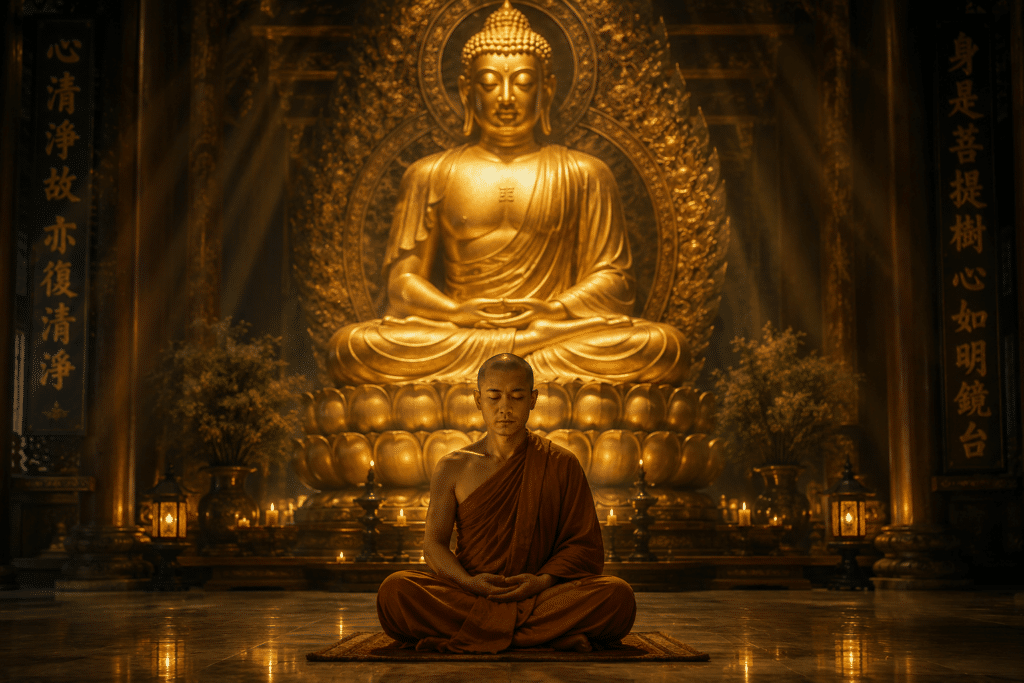
Nirvana Is the Extinguishing of the Fires of Greed, Hatred, and Delusion
The Sanskrit word Nirvana literally means “to blow out” or “to extinguish.” But what is extinguished?
According to Buddhism, it is not life, but the inner fires that keep us trapped in suffering. These fires are traditionally known as the Three Poisons:
- Greed (Lobha) – endless craving and attachment.
- Hatred (Dosa) – anger, resentment, and aversion.
- Delusion (Moha) – ignorance of reality.
Buddhism teaches that these three mental poisons constantly fuel Dukkha—the dissatisfaction, anxiety, and suffering that characterize ordinary existence.
Nirvana is reached when these causes are completely uprooted. The mind is no longer driven by endless wanting, fear, or confusion. Instead, it rests in clarity, compassion, and profound peace.
This is why many Buddhist texts describe Nirvana as “the cooling of the fires”.Rather than a dramatic event, it is the complete calming of a mind that no longer burns with attachment.
Nirvana Is Freedom from the Cycle of Suffering
One of Buddhism’s central teachings is impermanence (Anicca). Everything we experience—our bodies, emotions, relationships, achievements, and even our thoughts—is constantly changing.
Much of human suffering comes from resisting this reality. We try to hold on to what cannot last and reject what we cannot avoid.
According to Buddhism, this attachment keeps beings caught in Saṃsāra, the endless cycle of birth, death, and rebirth.
Nirvana is liberation from this cycle.
This does not simply mean dying. Buddhism emphasizes that Nirvana is fundamentally a transformation of the mind. A person who realizes Nirvana while still alive is no longer psychologically enslaved by craving, fear, or attachment.
Rather than being tossed about by changing circumstances, they experience an inner freedom that does not depend on external conditions.
In Buddhist philosophy, Nirvana is often described as the Unconditioned—a reality that is no longer governed by the endless arising and passing away of conditioned phenomena.
Nirvana Is Awakening to Reality, Not Becoming Nothing
One of the biggest misunderstandings about Buddhism is that Nirvana means becoming nothing or disappearing forever.
Buddhism does not describe Nirvana as simple annihilation.
Instead, Nirvana is awakening from ignorance. It is seeing reality as it truly is and no longer mistaking temporary phenomena for a permanent self.
Many Mahayana Buddhist traditions explain this awakening through the teaching of Buddha-nature (Tathāgatagarbha). According to these traditions, all beings possess the potential for enlightenment, although this wisdom is obscured by ignorance, attachment, and habitual thinking.
From this perspective, Nirvana is not about creating a new self. It is about removing the mental obscurations that prevent us from recognizing our true nature.
Different Buddhist schools explain this in different ways. For example, Theravāda Buddhism generally emphasizes the realization of Anattā (non-self), while many Mahayana traditions speak of uncovering one’s Buddha-nature. Although their language differs, both point toward liberation from ignorance and suffering rather than the creation of an eternal ego.
Nirvana Is the Highest Goal of Buddhist Practice
How does one move toward Nirvana?
According to Buddhism, this transformation is cultivated through the Threefold Training:
- Śīla (ethical conduct), which purifies one’s actions.
- Samādhi (meditative concentration), which steadies the mind.
- Prajñā (wisdom), which directly understands reality.
These practices gradually weaken greed, hatred, and delusion until they no longer dominate the mind.
Importantly, Buddhism does not present Nirvana as a reward granted by a creator God. It is the natural result of cultivating wisdom and freeing the mind from the causes of suffering.
Final Thoughts
So, what is Nirvana in Buddhism?
It is not heaven. It is not death. It is not the destruction of existence.
Nirvana is the complete cessation of greed, hatred, and delusion. It is liberation from Dukkha and freedom from the cycle of Saṃsāra. It is the awakening of a mind that sees reality clearly and is no longer bound by attachment.
Whether described as the cooling of the fires, the Unconditioned, or the realization of Buddha-nature, Nirvana represents the ultimate freedom that lies at the heart of Buddhist teaching.
For Buddhists, Nirvana is not about escaping life—it is about awakening to reality and living with wisdom, compassion, and lasting inner peace.
Buddhism Special Topic Buddhism