Many people wonder whether Buddhism is a religion or a philosophy. The answer is not as straightforward as it may seem.
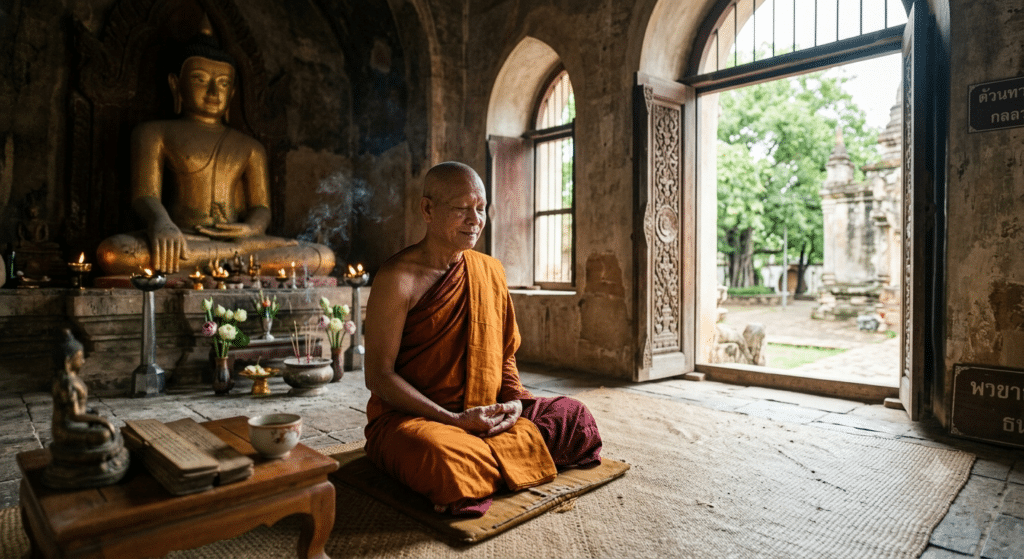
If you visit a Buddhist temple, you’ll find monks, rituals, chanting, and offerings—features commonly associated with religion. But if you read Buddhist teachings, you’ll encounter profound discussions about the nature of reality, consciousness, suffering, and the mind—subjects often explored in philosophy.
So which is it?
The short answer is that Buddhism can be understood as both a religion and a philosophy. Yet neither label fully captures its true purpose. At its heart, Buddhism is a practical path of cultivation aimed at awakening (Bodhi) and freedom from suffering (Nirvāṇa).
Why Is Buddhism Considered a Religion?
From an external perspective, Buddhism clearly possesses many characteristics of a religion.
Across Asia and increasingly around the world, Buddhists gather in temples, observe ethical precepts, participate in ceremonies, honor the Buddha, and follow traditions that have been preserved for centuries. These practices create communities, transmit teachings, and provide spiritual support during life’s most difficult moments.
However, Buddhism generally understands these religious forms differently from many theistic religions.
Rather than being ends in themselves, rituals and precepts are often regarded as Upāya, or “skillful means.” Upāya refers to methods that help people gradually develop wisdom and compassion according to their own abilities.
For example, observing the Five Precepts is not merely about obeying divine commandments. Instead, it is a practical way of reducing harmful actions, calming the mind, and creating the conditions for deeper insight.
In this sense, Buddhism certainly functions as a religion, but its religious practices are primarily intended to support inner transformation rather than secure divine favor.
Why Do Many People See Buddhism as a Philosophy?
At the same time, Buddhism is widely studied as one of the world’s great philosophical traditions.
Unlike systems built around belief in a Creator God, Buddhism focuses on understanding the causes of human suffering and investigating the nature of experience.
One of its central teachings is Dependent Origination (Pratītyasamutpāda)—the principle that all phenomena arise through causes and conditions. Nothing exists independently or permanently.
This insight naturally leads to another foundational idea: Śūnyatā, often translated as “emptiness.” Emptiness does not mean that nothing exists. Rather, it means that things lack an independent, fixed essence because everything exists through relationships and conditions.
Buddhism also encourages careful inquiry rather than blind acceptance. A well-known passage from the Kalama Sutta advises people not to accept teachings simply because they come from tradition or authority, but to examine them through experience and wisdom.
Because of this emphasis on observation, reasoning, and direct investigation, many scholars describe Buddhism as a philosophical tradition.
Why Neither Label Fully Describes Buddhism
Although Buddhism contains both religious and philosophical elements, many practitioners believe that neither term fully explains what Buddhism actually is.
Religion often emphasizes faith.
Philosophy often emphasizes understanding.
Buddhism values both, but ultimately points toward practice.
Its central question is not simply:
“What should I believe?”
or
“What is ultimately true?”
Instead, it asks:
“How can suffering (Dukkha) come to an end?”
This practical orientation distinguishes Buddhism from systems that remain primarily intellectual.
In Buddhist tradition, wisdom is called Prajñā—not merely knowledge, but direct insight into the nature of reality. Such insight is cultivated through ethical living, meditation, mindfulness, and continuous self-observation.
In other words, Buddhism is not simply about thinking differently.
It is about becoming different.
Awakening Is More Important Than Labels
From the Buddhist perspective, doctrines and concepts are valuable only if they help transform one’s life.
A famous Buddhist metaphor compares teachings to a raft used to cross a river. Once the river has been crossed, there is no need to carry the raft on one’s back.
Likewise, philosophical theories, religious rituals, and even Buddhist doctrines are considered means rather than final destinations.
The ultimate goal is Bodhi, or awakening—a profound realization that dissolves ignorance (Avidyā), weakens attachment (Upādāna), and opens the possibility of genuine compassion and inner freedom.
This is why Buddhism often describes itself as a Dharma, meaning a path or teaching that guides one toward liberation, rather than merely a belief system.
Conclusion
So, is Buddhism a religion or a philosophy?
The most balanced answer is both.
It functions as a religion through its communities, rituals, ethical disciplines, and spiritual traditions.
It functions as a philosophy through its profound analysis of the mind, suffering, and reality.
Yet these descriptions only reveal different aspects of Buddhism.
Ultimately, Buddhism is best understood as a path of practice—a way of cultivating wisdom (Prajñā), compassion (Karuṇā), and awakening (Bodhi).
Rather than asking us to choose between religion and philosophy, Buddhism invites us to ask a more practical question:
Can this path help us understand ourselves, reduce suffering, and live with greater wisdom and compassion?
For many Buddhists, that question is far more important than the label itself.
Buddhism Special Topic Buddhism