When people first encounter Buddhism, one question often comes up:
Do Buddhists believe in God?
The answer is more nuanced than a simple yes or no.
Unlike many religions, Buddhism does not teach that the universe was created or governed by an all-powerful Creator God. However, Buddhism does recognize the existence of devas—heavenly beings that are often translated as “gods.” Understanding who these devas are helps explain why Buddhism is neither traditionally theistic nor strictly atheistic.
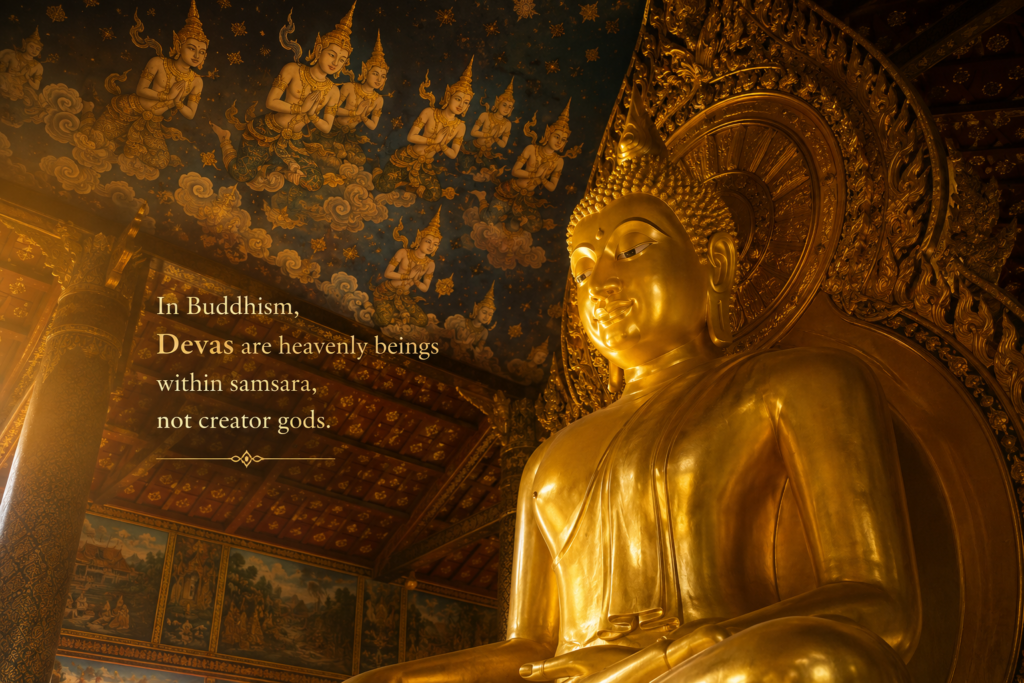
Buddhism Recognizes Devas, but They Are Not Creator Gods
Buddhist scriptures describe many devas (Sanskrit: deva; Pali: deva), including well-known figures such as Śakra (Indra) and Brahmā. These celestial beings inhabit heavenly realms and possess extraordinary lifespans, beauty, and abilities.
However, their role is fundamentally different from the concept of God in Abrahamic religions.
In Buddhism, devas did not create the universe. They do not determine human destiny, forgive sins, or grant ultimate salvation. While some Buddhist traditions show respect toward devas, Buddhists do not rely on them for liberation.
Instead, Buddhism teaches that every being—including devas—is subject to karma, the law of cause and effect. Each individual is ultimately responsible for their own actions and spiritual development.
For this reason, enlightenment cannot be given by a god. It must be realized through one’s own cultivation of wisdom, ethical conduct, and meditation.
What Exactly Are Devas?
If devas are not creators, then who are they?
Buddhism describes existence as saṃsāra—the continuous cycle of birth, death, and rebirth. Within this cycle are multiple realms of existence, one of which is the heavenly realm where devas live.
From the Buddhist perspective, devas are simply another category of sentient beings.
Their heavenly existence is not a privilege granted by a supreme deity. Rather, it is the natural result of wholesome karma and accumulated merit (puṇya) from previous lives. Because of these past actions, devas enjoy lives of immense happiness, long lifespans, and subtle pleasures that far exceed those of ordinary humans.
One way to understand this is to imagine someone enjoying the rewards of many years of hard work. Their fortunate circumstances are real, but they are not permanent, nor do they make them fundamentally different from everyone else.
Likewise, devas are still beings within saṃsāra. They have not yet attained complete awakening.
Even the Gods Are Impermanent
One of the most distinctive teachings in Buddhism is impermanence (anicca).
Everything that arises will eventually pass away—including heavenly beings.
Although devas may live for unimaginably long periods of time, their lives are not eternal. When the positive karma that supported their heavenly rebirth is exhausted, they too must die and be reborn according to their remaining karma.
Traditional Buddhist texts even describe signs that appear shortly before a deva’s death, known as the “Five Signs of Heavenly Decline.” These signs remind practitioners that even the highest heavenly existence cannot escape impermanence.
This teaching surprises many people because it presents a radically different view of divinity. In Buddhism, even gods are not beyond change, suffering, or rebirth.
Heaven, therefore, is a temporary destination—not the final goal.
Why Do Some Devas Protect Buddhism?
Readers sometimes notice that Buddhist temples contain images of heavenly beings or guardian figures.
Does this mean Buddhists worship them?
Not exactly.
In many Buddhist traditions, certain devas are described as having encountered the Buddha, understood the Dharma, and chosen to support its preservation. Rather than ruling the universe, they serve as protectors of the Dharma (Dharmapālas) by safeguarding Buddhist teachings and encouraging sincere practitioners.
This reflects an important Buddhist principle: spiritual greatness is not measured by power or status, but by wisdom, compassion, and the willingness to support the path toward awakening.
Even devas, according to Buddhism, can continue learning and progressing on the path.
The Goal of Buddhism Is Not to Become a God
Because heavenly life is temporary, Buddhism does not encourage people to seek rebirth in heaven as the highest achievement.
In fact, Buddhist teachings often suggest that the human realm offers a unique opportunity for spiritual practice. Human life contains both joy and suffering, making it easier to recognize the nature of existence and develop the motivation to seek awakening.
The ultimate goal of Buddhism is Nirvana (Nibbāna)—complete liberation from greed, hatred, delusion, and the endless cycle of saṃsāra.
From this perspective, becoming a deva is certainly a fortunate rebirth, but it is not the destination.
The Buddhist path aims at something far greater: awakening to reality as it truly is and attaining a freedom that no external being can grant or take away.
Final Thoughts
So, do Buddhists believe in God?
The answer depends on what we mean by “God.”
If we mean an all-powerful Creator who governs the universe and determines humanity’s destiny, Buddhism does not teach such a being.
If we mean the existence of powerful heavenly beings, then yes—Buddhism recognizes devas. Yet these devas are neither creators nor eternal rulers. They are sentient beings living within saṃsāra, subject to karma, impermanence, and rebirth, just like everyone else.
Ultimately, Buddhism points beyond both human and heavenly existence. Its central message is that true freedom comes not from depending on a god, but from awakening one’s own mind through the practice of the Dharma.
Buddhism Special Topic Buddhism